
Home / Case Studies / How SPECTRAFORCE Reduced .NET Delivery Costs by 45% with Nearshore Staffing in Costa Rica
U.S.-based consulting organizations face increasing pressure from rising labor costs, compressed delivery timelines, and sustained demand for specialized engineering talent. While .NET remains core to enterprise application development, experienced U.S.-based developers now command premium bill rates that challenge margin sustainability.
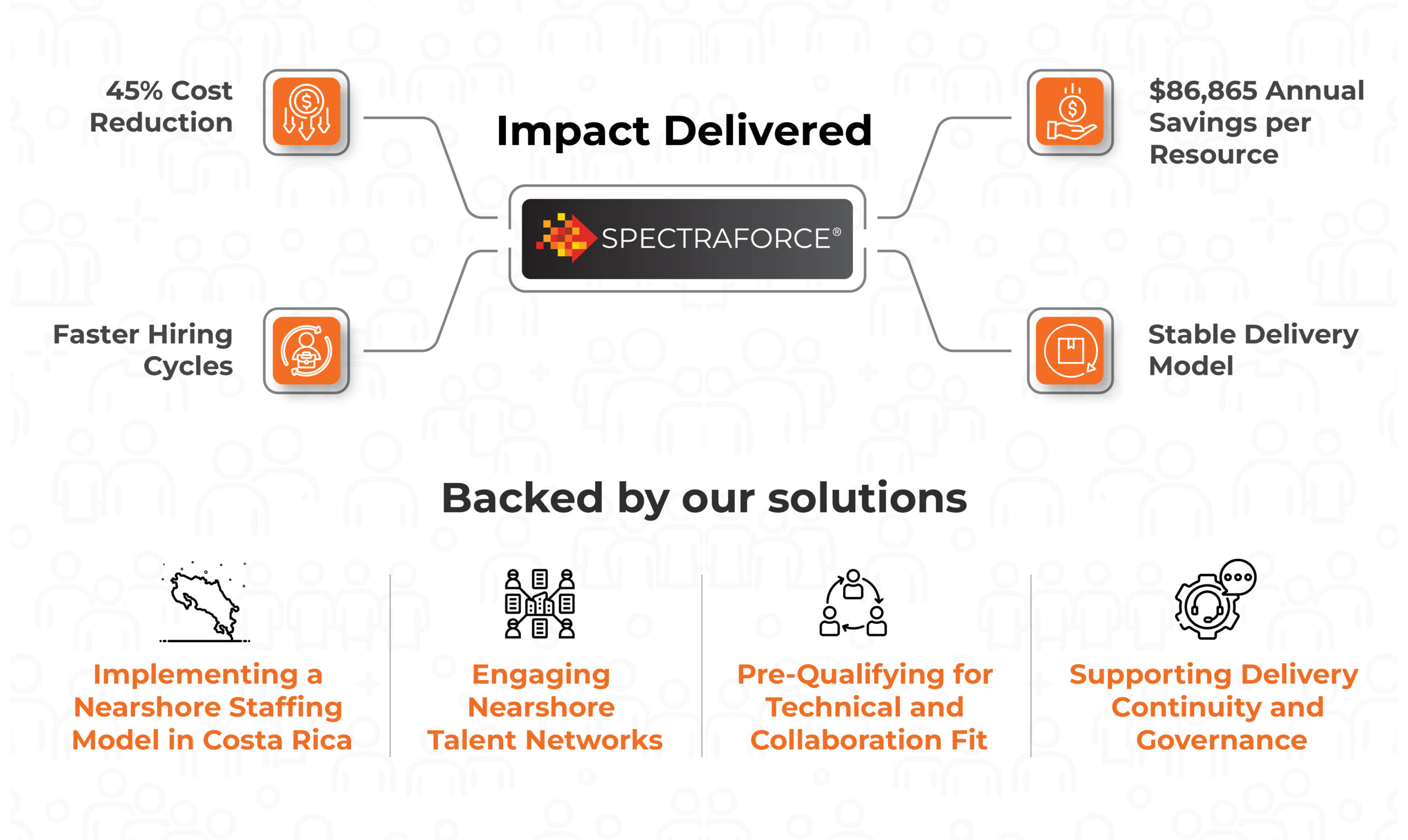
To balance delivery quality with cost efficiency, a U.S.-based consulting firm partnered with SPECTRAFORCE to implement a nearshore staffing model in Costa Rica. The engagement delivered 45% cost savings per .NET developer while maintaining collaboration efficiency and delivery continuity.
The firm required an experienced .NET Developer to support enterprise application development and active client engagements. The role demanded strong technical expertise and close collaboration with U.S.-based stakeholders.
However, comparable U.S.-based developers charged annual billing rates approaching $195,000, limiting the firm’s ability to scale delivery without margin erosion. In addition to cost pressure, the organization needed faster hiring cycles, predictable labor costs, and the flexibility to scale teams without long-term risk exposure.
SPECTRAFORCE introduced a nearshore delivery model anchored in Costa Rica, selected for its strong engineering talent pool, English proficiency, time-zone alignment, and stable labor market. The approach focused on aligning nearshore staffing with the firm’s existing delivery model rather than treating it as a short-term cost lever.
Key selection factors included:
SPECTRAFORCE leveraged its regional talent networks to identify .NET developers with experience in enterprise application development and client-facing delivery environments. Screening emphasized both technical capability and collaboration readiness to ensure seamless integration into distributed teams.
Shortlisted candidates were assessed against role-specific criteria, including .NET expertise, enterprise application exposure, familiarity with structured delivery methodologies, and comfort working with U.S.-based stakeholders.
Nearshore developers sourced through this model had an average annual billing rate of $108,135, which was significantly lower than that of U.S.-based developers.
The nearshore model emphasized stability through Costa Rica’s relatively low attrition rates and established delivery infrastructure. This supported consistent staffing, reduced onboarding disruption, and predictable workforce planning as project demand evolved.
Transitioning the .NET Developer role to Costa Rica delivered both financial and operational benefits.
From a cost perspective, the firm achieved a 45% reduction in annual bill rate, generating $86,865 in annual savings per resource. These savings improved margin protection while preserving delivery quality.
Operationally, the model enabled faster hiring cycles and greater flexibility to scale capacity without increasing exposure to volatile domestic labor markets. Stable nearshore delivery also reduced disruption risks related to attrition and talent shortages.
Nearshore staffing in Costa Rica enabled consistent collaboration with U.S.-based teams through time-zone alignment and strong English proficiency. This supported real-time communication, faster onboarding, and stable workforce planning across active client engagements.
Costa Rica’s mature nearshore ecosystem provided access to enterprise-experienced developers within a predictable labor market, reducing dependency on constrained domestic talent pools and strengthening long-term operational resilience.
As competition for specialized engineering talent intensifies, rigid onshore-only staffing models are becoming increasingly difficult to scale. Nearshore delivery offers consulting organizations a practical way to balance cost, speed, and quality.
SPECTRAFORCE’s Costa Rica nearshore model demonstrates how disciplined execution and thoughtful location strategy can convert talent sourcing into a sustained business advantage.
Share via:
Verify Recruiter
