
Home / Case Studies / How SPECTRAFORCE Built AI-Ready Data Infrastructure for a Global Engineering and Construction Organization
A global engineering and construction organization needed to modernize its data ecosystem to support large-scale infrastructure programs with stronger data accessibility, faster reporting, and AI-ready analytics.
With complex project lifecycle data spread across multiple systems, the organization needed specialized data engineering talent capable of building scalable pipelines, supporting Azure Data Lake and Databricks architecture, and preparing enterprise data for predictive and generative AI use cases.
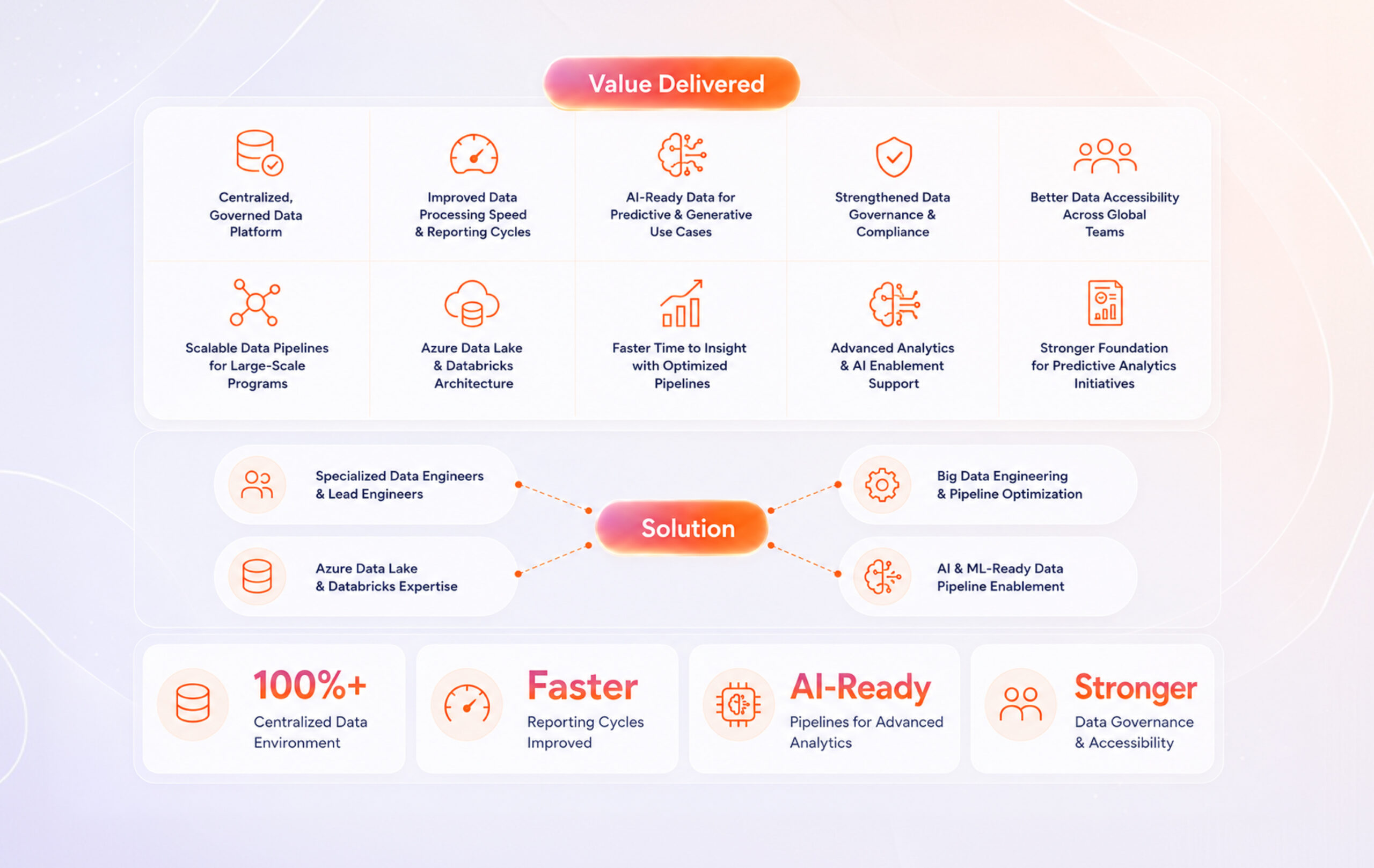
SPECTRAFORCE delivered specialized Data Engineers and Lead Engineers with expertise in modern data platforms, big data engineering, and ML-ready architecture.
Results at a glance
Through SPECTRAFORCE data engineering and AI talent support, the client was able to:
The client was managing massive volumes of structured and unstructured data across multiple systems. Its goal was to build a scalable, governed data platform capable of supporting real-time insights, predictive analytics, and AI-driven decision-making across global operations.
The work required talent with expertise across three connected areas:
1. Data layer: Large-scale pipeline development and optimization across distributed systems
2. Platform layer: Azure Data Lake and Databricks-based architecture design
3.Intelligence layer: AI and machine learning readiness for predictive and generative analytics
The primary challenge was finding engineers who could combine big data engineering, AI enablement, and enterprise governance within one scalable delivery model
SPECTRAFORCE deployed specialized Data Engineers and Lead Engineers with deep expertise in modern data platforms and AI-ready architectures.
The talent strategy focused on helping the client build a stronger enterprise data foundation while preparing its data environment for advanced analytics and AI use cases.
SPECTRAFORCE provided resources with expertise in:
This approach helped the client improve how data was structured, governed, processed, and accessed across complex project environments.
With specialized data engineering support in place, the client improved its enterprise data infrastructure and strengthened its ability to support advanced analytics at scale.
Key outcomes included:
SPECTRAFORCE provided skilled Data Engineers to help design and implement a unified Azure Data Lake architecture, giving the client a more scalable data environment for enterprise-wide data governance and accessibility.
Data Engineering and AI-focused talent helped build machine learning-ready pipelines, preparing data for predictive analytics and future AI-driven use cases.
Big Data Engineers helped optimize and streamline data pipelines, improving processing speed and supporting faster reporting across business and project teams.
Cross-functional teams gained access to more reliable, analytics-ready data, helping improve visibility across complex infrastructure programs.
| Challenge | SPECTRAFORCE Approach | Outcome |
| Fragmented data across systems | Provided skilled Data Engineers to design and implement a unified Azure Data Lake architecture | Centralized, governed enterprise data platform |
| Limited AI readiness | Supplied Data Engineering and AI-focused talent to build ML-ready data pipelines | Faster rollout of predictive analytics initiatives |
| Performance bottlenecks | Deployed Big Data Engineers to optimize and streamline data pipelines | Improved processing speed and faster reporting cycles |
The engagement helped the client bring fragmented project data into a more centralized, governed environment built for faster reporting and future AI use cases.
By delivering specialized data engineering talent with experience across Azure Data Lake, Databricks, enterprise data pipelines, governance, and AI enablement, SPECTRAFORCE helped a global engineering and construction organization improve cross-functional data access, reduce pipeline friction, and support more advanced infrastructure program analytics.
Share via:
Verify Recruiter