Data center workforce planning should begin early and evolve with each stage of the infrastructure lifecycle.
AI adoption, cloud expansion, and the growing demand for digital services are accelerating investment in data center infrastructure.
For organizations planning new facilities, expanding existing campuses, or modernizing infrastructure, physical capacity represents one part of the challenge. Every project also depends on having qualified people available at the right time.
Data center workforce planning is the process of forecasting, sourcing, and securing the talent needed to design, build, commission, operate, and expand a facility. The goal is to align hiring timelines with infrastructure milestones, so critical roles are available before workforce gaps begin affecting project schedules.
Effective planning considers more than headcount. Employers also need to account for specialized skills, local talent supply, certifications, project duration, shift requirements, compensation, and the amount of mission-critical experience required for each role.
Starting this process early gives employers more time to develop pipelines, adjust recruiting strategies, and choose the right workforce model for each stage of the project.
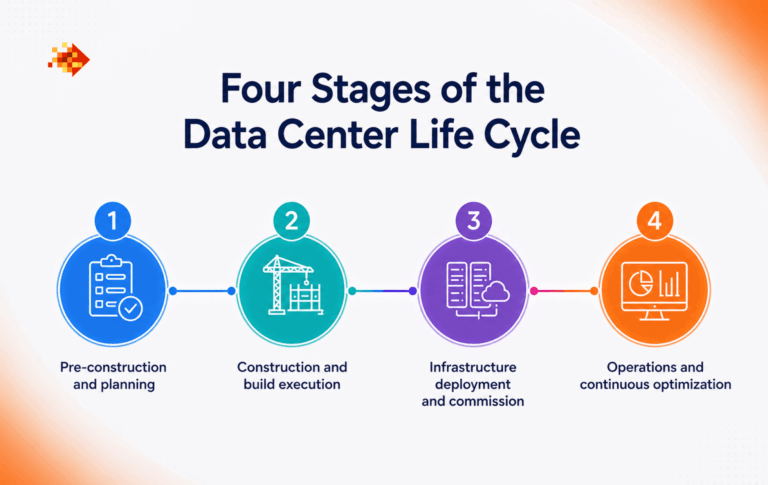
| Data center lifecycle phase |
Primary talent needs | When hiring should begin |
Likely workforce models |
|---|---|---|---|
| Pre-construction | Project managers, engineers, estimators, procurement | Before site/build decisions are finalized | Direct hire, contract |
| Construction | Construction management, electricians, HVAC, skilled trades | Ahead of mobilization | Contract, high-volume staffing |
| Commissioning | Commissioning engineers, network engineers, controls specialists | Before systems testing begins | Contract, SOW |
| Operations | Critical facilities, technicians, network operations, reliability | Before commissioning ends | Direct hire, contract |
The Bureau of Labor Statistics projects employment for electricians to grow 9% from 2024 through 2034, with approximately 81,000 openings annually. Employment for heating, air conditioning, and refrigeration professionals is projected to grow 8% over the same period.
Electrical systems, cooling infrastructure, networks, controls, racks, and monitoring platforms must work together before the facility can become fully operational.
Employers frequently need to scale commissioning and deployment teams around specific testing and cutover windows. Delays in finding qualified commissioning or integration talent can affect testing schedules, deployment timelines, and operational readiness.
Flexible staffing or project-based delivery models can help organizations meet these concentrated demand periods while maintaining access to specialized expertise.
Facilities need trained teams ready to maintain uptime, respond to incidents, manage equipment, monitor capacity, and support future growth.
Hiring plans should also account for shift coverage, on-call requirements, escalation procedures, security clearances, certifications, and succession planning.
Operational teams develop valuable institutional knowledge about the facility. Involving them before commissioning ends can improve knowledge transfer and create a smoother transition into live operations.
The right workforce model depends on the project phase, hiring timeline, location, specialization required, budget, and long-term operating plan. Large data center programs often use several models across the lifecycle.
Contract staffing can support project-based demand, construction and deployment surges, specialized expertise, and roles tied to defined timelines.
Direct hire is well suited for operational leadership, critical facilities positions, engineering roles, and other positions where long-term continuity and institutional knowledge are important.
Statement of Work solutions can support defined technical deliverables, infrastructure deployments, modernization initiatives, and other outcome-based projects.
High-volume or onsite workforce support can help programs that require coordinated recruiting, onboarding, workforce care, and day-to-day management across larger groups of workers.
The workforce mix may also change as the facility progresses. A project can rely more heavily on flexible labor during construction and commissioning, then increase permanent hiring as the operation approaches go-live.
Planning those transitions in advance helps employers avoid abrupt hiring spikes and creates clearer ownership across internal teams and workforce partners.
A strong data center staffing partner should understand how talent needs change across the lifecycle and be able to recruit across several interconnected labor markets. That can include engineering, construction, skilled trades, information technology, networking, facilities, security, and operations.
The connection between roles matters as much as the individual requisitions. A workforce partner should understand how construction activity moves into commissioning, how commissioning moves into operations, and how operational requirements can shape future expansions.
That lifecycle view can help employers make hiring decisions with the next project milestone in mind
The most effective data center workforce strategies are developed alongside infrastructure plans. Mapping roles, hiring lead times, talent availability, and workforce models to project milestones gives employers earlier visibility into potential constraints.
That visibility can help organizations set more realistic hiring timelines, understand workforce costs, expand recruiting regions when necessary, and begin building pipelines for specialized roles before demand peaks.
The most effective data center workforce strategies are developed alongside infrastructure plans. Mapping roles, hiring lead times, talent availability, and workforce models to project milestones gives employers earlier visibility into potential constraints.
That visibility can help organizations set more realistic hiring timelines, understand workforce costs, expand recruiting regions when necessary, and begin building pipelines for specialized roles before demand peaks.
SPECTRAFORCE supports workforce needs across technology, engineering, infrastructure, and operations through contingent staffing, direct hire, and Statement of Work solutions. Our teams combine recruiting expertise, market intelligence, and Leoforce, our AI-driven talent intelligence platform developed by our sister company and long-standing technology partner. Together, these capabilities help organizations identify specialized talent, scale hiring, and support complex workforce programs across the infrastructure lifecycle.
Our teams combine recruiting expertise, market intelligence, and Leoforce, our AI-driven talent intelligence platform developed by our sister company and long-standing technology partner. Together, these capabilities help organizations identify specialized talent, scale hiring, and support complex workforce programs across the infrastructure lifecycle.

Integrated Marketing Manager at SPECTRAFORCE focused on brand visibility, content strategy, search, and thought leadership.
Data center workforce planning should begin during the early planning stage, before construction starts. This gives employers more time to assess local talent supply, build hiring timelines, and address potential skill shortages before they affect project schedules.
Talent needs vary by lifecycle stage. Common roles include engineers, project managers, electricians, HVAC specialists, commissioning professionals, data center technicians, critical facilities engineers, network professionals, and operations leaders.
Local labor supply can affect how easily an organization staffs construction, commissioning, and operations. Evaluating talent availability early can help employers identify regional skill gaps and plan recruiting, relocation, or training strategies.
Many data center programs use both. Contract staffing can support temporary or project-based demand, while direct hire is often better suited for long-term operational, leadership, and specialized roles that require continuity.
Employers should look for a partner that can recruit across multiple talent categories, provide labor-market intelligence, support different workforce models, and scale with hiring needs from pre-construction through operations.
SPECTRAFORCE can help from finding candidates to delivering outcomes.

How to Evaluate React Developers : Technical and Product Skills Checklist Makayla Adams When assessing React developer candidates, consider skills

Software Development Team Structure: Roles to Hire at Each Stage Mariana Cajina Building software is rarely about hiring a big

Modern Data Team Structure: Analytics, Engineering and Governance Roles Makayla Adams Creating a dashboard to centralize your data doesn’t fix
Verify Recruiter