
Home / Workforce White Papers & Research | SPECTRAFORCE / Make Hiring Predictable by Design

A practical buyer’s guide to choosing,
structuring, and scaling Recruitment
Process Outsourcing (includes 2
results-oriented checklists)
What happens when your most urgent projects can’t wait for hiring to catch up?
Recruitment Process Outsourcing (RPO) is a workforce solution where an organization partners with an external provider to manage part or all its hiring process—from sourcing and screening to hiring and onboarding. Rather than adding more internal resources, companies use RPO to create a more scalable, consistent, and performance-driven recruitment engine.
Hiring hasn’t become harder because teams are doing less. It’s become harder because the systems supporting hiring were built for a world that moved more slowly.
Demand now shifts faster than workforce plans can adjust. Growth initiatives, expansions, and evolving skill requirements introduce constant variability into hiring pipelines. Yet recruiting teams are still expected to deliver speed, quality, and cost efficiency with operating models designed for steadier, more predictable conditions.
Industry benchmarks reflect this mismatch. The Society for Human Resource Management reports that the median time-to-fill in the U.S. is approximately 44 days, rising further for specialized and technical roles.
What this creates is not simply slower hiring, but uneven outcomes. Timelines become harder to commit to. Pipeline quality varies across roles. Even strong teams struggle to deliver the same level of consistency quarter after quarter.
Over time, these small gaps compound.
When variability becomes the norm, predictability stops being a planning issue and becomes a structural one.
Designing for reliable hiring outcomes requires more than incremental fixes. It requires rethinking how recruiting capacity is structured, deployed, and governed in a world where demand rarely stands still. That’s where Recruitment Process Outsourcing services come into play.

(is the average time-to-fill in the United States)
What hiring unpredictability looks like

Requests pause and restart multiple times

Hiring velocity varies (a lot) by team/region

Recruiters juggle volume without clear capacity models

Quality drops when speed becomes the default lever
One of the biggest barriers to successful RPO adoption is misunderstanding the model itself.
RPO is not a staffing substitute, nor is it simply an outsourced recruiting vendor. At its core, RPO is a long-term partnership in which a provider designs and manages all of an organization’s permanent hiring process with dedicated capacity, governance, and measurable outcomes.
What happens when your most urgent projects can’t wait for hiring to catch up?
RPO delivers the most value when hiring pressure is sustained, complex, or variable—not when it’s occasional.
Here are four common scenarios where Recruitment Process Outsourcing Services become a strategic advantage.
What happens when your most urgent projects can’t wait for hiring to catch up?
Organizations hiring continuously across locations often struggle to maintain consistent pipelines and employer branding. RPO introduces dedicated capacity aligned by function or geography.
SHRM research consistently shows that heavy reliance on agencies drives higher cost-per-hire. RPO replaces reactive spend with a predictable delivery model.

Greenfield sites, new product launches, or digital transformations create time-bound hiring spikes that overwhelm internal teams. Project RPO initiatives allow rapid ramp-up without long-term overhead.
When recruiters are managing excessive requisition loads, quality and experience suffer. RPO services redistribute workload without adding permanent headcount.
Not every organization starts with a full enterprise RPO. Many begin with a pilot— owning a role, family, geography, or hiring segment— before expanding scope.
One of the most important decisions buyers make when evaluating a Recruitment Process Outsourcing Service is not whether to use RPO, but how it should be structured. RPO is intentionally flexible by design. A well-structured program aligns recruiting capacity with business demand without forcing organizations into an all-or-nothing model.
The right structure depends on three variables:
Organizations that treat RPO as a monolith often struggle to see results, while those that match structure to need tend to stabilize faster and achieve stronger long-term outcomes. Here’s a breakdown of the different RPO models at the enterprise and project levels.
Enterprise RPO is designed for organizations with sustained, high-volume hiring across regions, business units, or job families. In this model, the RPO partner assumes end-to-end ownership of permanent hiring within an agreed scope.
Execution typically includes demand planning, recruiter alignment by function or geography, standardized hiring workflows, and governance through service-level agreements (SLAs) and operating cadences. For leadership teams, the Enterprise model offers predictability, with clear capacity planning, consistent delivery, and transparent reporting across the entire hiring portfolio.
This RPO model is particularly effective when hiring is continuous rather than episodic, and when internal teams need relief from constant reprioritization. By embedding dedicated recruiting pods, Enterprise RPO reduces variability and creates a stable operating rhythm that scales with business growth.
Recruitment Process Outsourcing services, at the project level, are purpose-built for time-bound hiring initiatives where speed and throughput matter most. Common use cases might include:
Unlike the Enterprise model, Project RPO has a clearly defined start and end point. The focus is on rapid ramp-up, disciplined execution, and clear milestones. This allows organizations to meet aggressive hiring timelines without permanently expanding internal headcount or overloading existing recruiters.
Project RPO works best when scope, timelines, and success criteria are clearly articulated upfront. When structured well, it delivers momentum during critical periods while preserving flexibility once the project concludes.
Hybrid RPO blends internal TA ownership with external delivery support. In this model, responsibilities are intentionally split—by role type, function, geography, or hiring stage—between the internal team and the RPO partner.
This approach appeals to organizations that want to retain strategic control over certain roles or relationships while gaining scale and consistency elsewhere. Success depends heavily on clear segmentation, shared metrics, and unified reporting. Without this clarity, Hybrid RPO can introduce duplication or confusion.
When executed effectively, Hybrid RPO allows organizations to extend capacity where pressure is highest while preserving institutional knowledge and internal accountability.
Modular or on-demand Recruitment Process Outsourcing services provide targeted support for specific recruiting activities rather than full-cycle ownership. Common modules include:
This structure is often used as an entry point into RPO or as a pressure-release mechanism during peak hiring periods. It enables internal teams to stay focused on high-value work while accessing specialized support exactly where it is needed.
Modular Recruitment Process Outsourcing services are most effective when demand is uneven across roles or stages of the hiring funnel. It offers flexibility without long-term commitment and can evolve into broader engagement as hiring needs mature.
Choosing the right RPO structure is not about selecting the most comprehensive option, but the most appropriate one. Organizations that align structure to demand patterns, timelines, and internal bandwidth consistently see better adoption, faster stabilization, and more reliable hiring outcomes.
Strong RPO execution rarely draws attention when it’s working well. Instead of constant escalations or last-minute course corrections, hiring progresses at a steady pace that feels controlled and predictable to internal stakeholders.
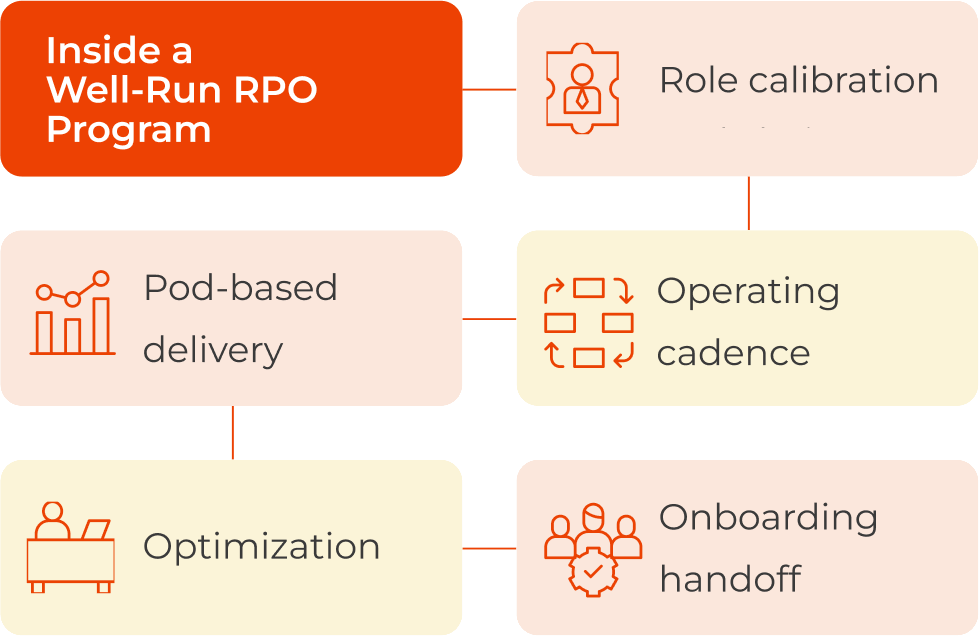
At a practical level, mature RPO execution is anchored around a few core building blocks that show up consistently, day after day. Here are a few examples of what your organization would see with the successful execution of an RPO solution:
Every role begins with structured intake and calibration. This goes beyond job descriptions to define success profiles, must-have skills, deal-breakers, and realistic timelines. Early clarity reduces downstream rework and helps recruiters prioritize quality over volume.
Recruiters are aligned deliberately rather than spread across unrelated roles. Pod-based delivery—organized by function, business unit, or geography—allows recruiters to build market expertise, strengthen relationships with hiring managers, and deliver consistent candidate messaging.
Execution follows a predictable operating rhythm. Intake and prioritization reviews keep effort focused on the most critical roles. Weekly or biweekly check-ins review funnel health, aging requisitions, and conversion trends, enabling teams to course-correct before issues escalate.
Hiring managers stay involved without being overloaded. Expectations around feedback timelines, interview participation, and decision ownership are clearly defined. This balance maintains momentum while protecting leaders’ time and attention.
Experience quality plays a central role in determining whether hiring efforts translate into successful outcomes. Even when compensation and role scope are competitive, having inconsistent or unclear experiences across the hiring journey can undermine results.
Candidate expectations, in particular, have evolved. Timely communication, transparency around timelines, and a structured process are now baseline expectations rather than differentiators. At scale, these experience gaps accumulate. Poor communication or frequent delays weaken employer brand perception, increase drop-off rates across the funnel, and force recruiting teams to work harder to maintain pipeline momentum.
Recruitment Process Outsourcing services are designed to introduce consistency into these interactions. Standardized candidate communication frameworks ensure that expectations are set early and reinforced throughout the process. Clear ownership across stages reduces handoff friction and minimizes uncertainty for candidates.
Recruiter experience is equally critical. Sustained overload leads to fatigue, slower response times, and uneven candidate engagement.
Pod-based RPO delivery models help stabilize workloads by aligning recruiters to specific roles or business units, allowing them to build deeper context and manage candidate relationships more effectively. This focus improves consistency without increasing pressure.
Hiring managers also benefit from improved experience. Defined touchpoints, clear expectations for feedback, and predictable progress updates reduce frustration and improve collaboration. When managers understand where they need to engage and where they do not, decision-making becomes faster and more confident.
When candidate, recruiter, and hiring manager experiences are designed together, hiring outcomes improve naturally. Acceptance rates rise, time-to-fill becomes more predictable, and the overall quality of hire stabilizes over time.
Measuring hiring success is one of the most common areas where RPO engagements either create clarity—or add noise. Many organizations default to time-to-fill as the primary performance indicator because it is easy to measure and compare. While speed matters, it rarely tells the full story.
Time-to-fill is a lagging indicator. It shows what already happened, not why it happened or whether the outcome is sustainable. When overemphasized, it can encourage short-term trade-offs that weaken quality, experience, or retention.
Mature RPO programs take a more balanced approach by tracking a small set of metrics that reflect consistency, quality, and system health.
Tracking movement between stages—sourcing to screening, interviews to offers, offers to acceptances—reveals where friction actually exists. Conversion trends are often more actionable than raw volume numbers.
Acceptance rate is a strong signal of alignment between role expectations, candidate experience, and market competitiveness.
Consistent hiring outcomes depend on manager engagement. Simple pulse surveys or structured feedback loops help assess whether the process feels predictable, collaborative, and effective from the business side.
Post-hire indicators such as 90-day attrition or early performance feedback help validate whether hiring decisions are holding up beyond the offer stage.
As teams set up their RPO metrics, how often metrics are reviewed and acted upon is just as important as what is being measured.
The goal of measurement in RPO is not reporting volume, but decision support. Metrics should surface patterns early, guide prioritization, and inform course correction—without overwhelming stakeholders.
Cost is often the most sensitive part of the conversation around Recruitment Process Outsourcing services, and also one of the most misunderstood. Many buyers initially evaluate an RPO solution through the lens of program fees alone, without accounting for the broader economics of hiring.
In reality, hiring costs are rarely contained within a single line item. They are distributed across agency spend, recruiter overtime, prolonged vacancies, lost productivity, and inconsistent hiring outcomes. When demand fluctuates, these costs become harder to forecast and even harder to control.
Predictable RPO pricing models address this challenge by shifting organizations away from reactive, transaction-based spend toward a more stable operating model. By reducing dependency on contingency agencies, shortening vacancy duration through dedicated capacity, and improving recruiter efficiency, RPO helps bring greater cost discipline to hiring.
Control is a common concern among decision-makers considering RPO. In practice, strong RPO programs increase control rather than diminish it. Governance frameworks, defined service-level agreements, real-time dashboards, and regular business reviews provide clearer visibility into hiring performance than most fully in-house models.
Instead of micromanaging individual requisitions, leaders gain system-level oversight—understanding where capacity is deployed, how pipelines are performing, and where adjustments are needed. This shift from activity tracking to outcome governance is what allows organizations to maintain confidence as they scale hiring operations.
When cost, value, and control are evaluated together, Recruitment Process Outsourcing services move from being a procurement decision to an operating strategy—one that supports predictable hiring outcomes even as demand changes.
The value of RPO, however, should not be assessed on cost reduction alone.
Mature buyers evaluate RPO based on consistency of outcomes, quality of hire, and the ability to plan with confidence.
RPO is most effective when it aligns with a clear need, especially for teams navigating growth, complexity, or inconsistent hiring outcomes. Use this checklist to assess where your current model may be under strain and whether a more scalable, structured approach could improve results.
Not all RPO partners operate the same, and the right fit depends on how well their model aligns with your business, hiring goals, and internal systems. Use this checklist to evaluate what a strong partnership should look like and where providers may fall short.
While every organization’s hiring context is different, most successful implementations of an RPO solution follow a broadly similar progression. Understanding what this journey looks like helps set realistic expectations and builds confidence during the early stages.
Over time, Recruitment Process Outsourcing services become more adaptive. Data from early delivery informs refinements in sourcing strategies, screening criteria, and capacity planning. As trust builds, scope often expands—either across additional roles, regions, or business units—without disrupting existing delivery.
The key takeaway is that RPO impact compounds over time. Early discipline enables later flexibility, allowing organizations to scale hiring without reintroducing volatility.

The transition from evaluating Recruitment Process Outsourcing services to operating within them is a critical moment. When managed well, it feels seamless to internal teams. When rushed or undercommunicated, it can introduce unnecessary resistance. Successful transitions start with internal alignment. Stakeholders across HR, TA, procurement, and the business need clarity on scope, ownership, and success criteria. This alignment reduces uncertainty and prevents misinterpretation of roles once delivery begins.
Phased ownership transfer is equally important. Rather than switching all roles at once, many organizations sequence go-live by role group or region. This allows teams to adapt gradually while maintaining hiring momentum.Clear communication underpins the entire transition. Hiring managers need to understand how and when they will engage. Internal recruiters need visibility into how responsibilities shift. Transparency at this stage builds trust and accelerates adoption. When thoughtfully managed, RPO integration strengthens existing hiring operations instead of disrupting them.

SPECTRAFORCE supports organizations at different stages of RPO adoption, from modular entry points to enterprise-scale programs.
Whether you need immediate capacity relief or long-term predictability, the right starting point is identifying Recruitment Process Outsourcing services with a proven track record. Connect with us today to see how we can get you the hiring predictability you deserve.
Verify Recruiter
