
Most permanent hiring processes are losing their best candidates before the search has properly begun.
SHRM research puts the average time to fill a permanent role in the United States at 44 days. Industry data consistently shows that top candidates are off the market in roughly 10 days. That 34-day structural gap sits at the center of why so many permanent searches end in compromise, and why closing it requires more than pushing harder on the same process.
The cost of an open seat adds to the pressure. SHRM data via Mitratech estimates that every unfilled role costs organizations between $4,000 and $9,000 per month in lost productivity and delayed output. For senior and business-critical positions, that figure is considerably higher.
Top candidates are off the market in 10 days. Most hiring processes take 44. That gap is where permanent hiring breaks down.
The labor market has become unusually static over the past two years. Skilled professionals are holding positions they would otherwise leave, waiting for greater stability before committing to a move.
That latent dissatisfaction exists across most industries and role levels, and it rarely surfaces through job boards or inbound applications.
For TA and HR leaders, these conditions have raised the bar on what permanent hiring actually requires. The organizations making consistently strong permanent hires are working with a fundamentally different level of sourcing depth and process rigour, and the quality of their outcomes reflects that difference.
The question most TA leaders ask when considering an external direct hire partner is whether they can justify the cost. The more useful question is whether they have accurately calculated the cost of not using one.
SHRM benchmarks put the average cost per hire in the United States at $4,700 to $4,800, a figure that only covers the visible expenses. What it rarely accounts for is the productivity loss from an open seat, the manager’s hours absorbed by a prolonged search, or the full cost of a mis-hire that resets the process entirely.
When those factors enter the calculation, the economics shift considerably.
The scenarios where external partnerships deliver the clearest return share a common characteristic:
The role matters enough that getting it wrong costs more than getting it right with outside help.
Knowing what a good external partner should bring is one thing. Understanding how that actually gets executed is what separates a credible evaluation from a leap of faith.
A rigorous direct hire process runs through five stages, each producing a specific output that the next stage depends on. When any one of them is rushed or treated as administrative, the quality of the outcome degrades quietly until it surfaces as a mis-hire or a search that stalls.
A job spec tells you what you want. A real intake uncovers what you need.
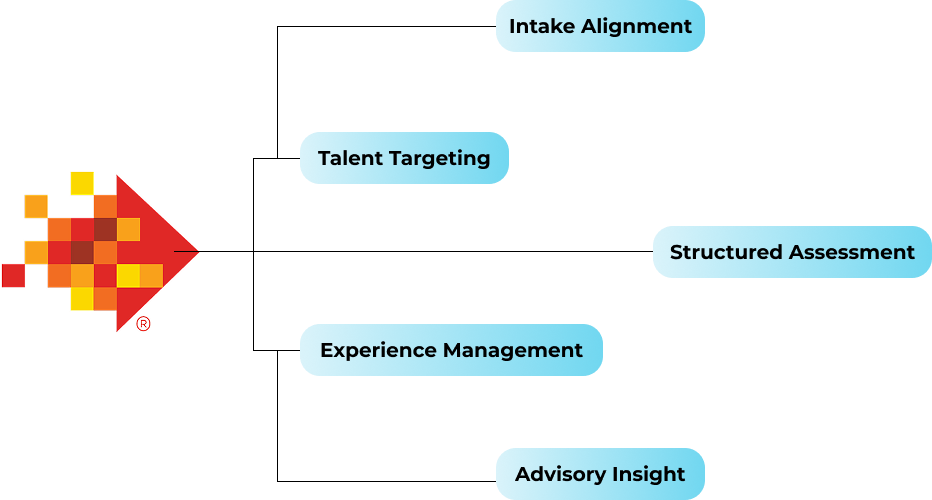
01 – Intake Alignment
Most intake meetings cover the job title and not much else. A rigorous one defines the outcomes the hire needs to deliver and surfaces the cultural context. Compensation reality belongs in this conversation, too, before sourcing begins.
02 – Talent Targeting
Build the candidate pool outward from the market, not just from inbound applications. The strongest candidates for most permanent roles are not actively looking.
03 – Structured Assessment
Evaluate candidates against defined competencies through behavioural interviewing and skills-based screening. Consistency at this stage is what separates defensible decisions from instinctive ones.
04 – Experience Management
Keep the process moving with clear candidate communication and a structured approach to the offer stage. This is where most searches unravel, and where preparation makes the difference.
05 – Advisory Insight
Provide compensation benchmarking and talent availability data throughout the search. This layer is what most clearly separates a strategic partner from a resume supplier.
For senior and executive roles, the same five stages apply, with considerably greater depth at every point. Search horizons are longer, and assessment goes deeper at every stage, with board and stakeholder context shaping the brief from the first conversation.
A well-run process gets the right candidate to the offer stage, and what happens next determines whether they actually start. The offer stage is where permanent hiring loses more ground than most organizations realize.
According to SHRM, 52% of employees who accepted a counteroffer from their current employer left within six months, and 80% had departed within a year.
The underlying reasons for wanting to leave rarely disappear because of a salary increase. Those reasons surface again, and the organization that invested in a careful search often finds itself restarting it.
Counter-offers have become a routine part of the permanent hiring landscape at every role level. When a candidate resigns, their current employer faces the immediate cost of replacement. Making a counteroffer is almost always cheaper in the short term. Candidates who are not prepared for that moment often accept without fully thinking through what follows.
Every candidate who goes through your hiring process forms a view of your organization. The ones you do not hire share that view, too.
The candidate experience during the process carries more weight at this stage than most organizations account for. How candidates are treated through interviewing and offer conversations directly shapes their confidence in the decision they are about to make.
A slow or disorganized process introduces doubt at exactly the moment commitment is required.
For TA and HR leaders, the offer stage rewards preparation. Market-aligned compensation reduces the risk of a counteroffer gaining traction. A partner who has already had that conversation with the candidate before the resignation is worth considerably more than a partner who has not.
Reaching the offer stage with the right candidate is one milestone. Knowing that hire delivered what the role needed is what actually matters.
Most organizations evaluate their hiring on metrics that describe process speed rather than placement outcomes. Time-to-fill measures how long the seat stayed empty, and cost-per-hire measures the search cost to run. Neither tells you whether the person now in the role was the right choice.
According to LinkedIn’s Future of Recruiting research, 88% of TA professionals agree that quality of hire is the most useful recruiting metric available, yet fewer than 40% track it consistently. That gap is where permanent hiring loses accountability after the placement is made.
The placement is only the beginning. What happens in the first twelve months is the actual result.
The post-hire signals that close this gap are practical to define. Hiring manager satisfaction at 30 and 90 days captures whether the hire is performing at the level required by the role. Retention at the twelve-month mark indicates whether cultural fit held beyond the initial commitment. Time to full productivity measures how quickly the hire becomes a net contributor rather than a net cost.
Together, these signals create a picture of placement quality that process metrics will never surface on their own.
| Metric | What It Tells You | Target |
|---|---|---|
| 30-day retention | Whether the hire cleared the commitment threshold | 95%+ |
| 90-day retention | Whether early fit signals are holding | 85%+ |
| 12-month retention | Whether the hire was genuinely right for the role | 70%+ |
| Time to full productivity | How quickly the hire delivered meaningful output | Under 6 months |
| Hiring manager satisfaction | Whether the process produced what the role required | Tracked at 30 and 90 days |
Building this into a business case for leadership is less complicated than most TA teams assume. The question to anchor it is simple: what does it cost when a permanent hire does not work out? Most organizations have never calculated that figure explicitly. When they do, the ROI conversation around external partnerships tends to resolve itself.
Most TA and HR leaders already sense where their permanent hiring model is under strain. Working through this checklist turns that sense into something specific and actionable.
Each area below surfaces a question worth asking before the next critical search begins. Where several areas produce uncomfortable answers, that pattern is worth addressing directly.
No single area in the red is cause for alarm on its own. A pattern across several is worth taking seriously, particularly where the roles involved carry real business consequences if the hire does not hold.
Choosing a direct hire partner is a different evaluation from choosing a recruitment vendor, and the questions worth asking reflect that difference.
Most partner pitches stay at the surface, covering turnaround time and candidate volume. This checklist looks further at the operating model and accountability structures that determine whether a partner genuinely extends your TA function or simply adds to your workload.
Hiring timelines slip when there is no shared agreement upfront on what good progress looks like at each stage. The table below defines the standard across both permanent and executive searches, and shows where the two tracks diverge in depth and duration.
Every firm in this space will describe itself as a partner rather than a vendor. The distinction worth making is how they behave between searches, when no active brief is running, and no one is watching the scorecard.
When a search ends with a transactional supplier, institutional knowledge walks out with the recruiter. A genuine TA extension holds that calibration across engagements, and the recruiter who ran the last search brings prior shortlist insight into the next brief without being asked.
The behaviours that separate the two are observable before a search begins.
SPECTRAFORCE’s direct hire and executive hiring model sits at the strategic end of that spectrum. The intake goes deeper than most, and the advisory layer runs throughout the search. Each engagement builds institutional knowledge that the next one draws on directly.
Most organizations use this guide to sharpen their thinking on permanent hiring and align internal stakeholders on what good looks like before engaging an external partner.
If the questions it has raised feel worth exploring further, the next step is a 15-minute discovery call.
The conversation has a simple purpose:
To understand where the current hiring model is under strain and whether there is a fit worth taking forward. There is no pitch and no proposal until both sides decide there is a reason for one.
Verify Recruiter
