
Choosing between a project manager and a project coordinator is not just about titles. It is about addressing the real gaps in how work is planned, tracked, and delivered.
When teams feel stretched thin or constantly behind, it is usually not because people are not putting in the effort. More often, it comes down to unclear responsibilities that create confusion and make day-to-day execution harder than it needs to be.
According to Wellingtone’s The State of Project Management 2026 report, only 36% of organizations mostly or always complete projects on time, indicating how common missed deadlines still are. And this is not just a scheduling issue. The 2020 PMI Pulse of the Profession® report found that 11.4% of investment is wasted due to poor project performance, often tied back to weak coordination and unclear ownership.
Getting clarity on who does what and when you actually need each role can be the difference between projects that stall and those that deliver.
So, let us break down what each role brings to the table and how choosing the right one can make your projects run much more smoothly.
Who is a Project Manager?
A project manager is essentially the strategic force behind a project. They focus on the bigger picture, what needs to be delivered, how much it can cost, how long it should take, and what risks might get in the way.
They do not just manage tasks. They align the project’s goals with the organization’s broader objectives and make decisions that directly impact business results.
Core Responsibilities
- Strategic Planning – Figuring out what the project should actually achieve, breaking it into clear milestones, and mapping out a practical roadmap to get there.
- Budget Ownership – Estimating costs, securing funding, and managing the financial health of the initiative.
- Risk Mitigation – Identifying potential roadblocks before they happen and creating contingency plans.
- Stakeholder Management – Acting as the primary point of contact for executives and clients, ensuring transparency and alignment.
- Resource Allocation – Determining which team members are needed and managing their workload to prevent burnout.
Who is a Project Coordinator?
A project coordinator is the operational backbone of a project, ensuring its smooth day-to-day execution. They work closely across teams to keep tasks organized, communication clear, and timelines on track.
Their focus is mainly on the “how” and “when” of getting things done, which allows the project manager to stay aligned with the broader vision and ensure the project delivers the intended outcomes.
Core Responsibilities
- Schedule Maintenance – Updating project timelines and ensuring team members meet their individual deadlines.
- Documentation – Keeping track of key project records, such as contracts, meeting notes, and status updates, so there is always a clear, reliable record of what has been agreed and done.
- Logistics and Meetings – Organizing stand-ups, distributing agendas, and facilitating communication between departments.
- Task Tracking – Monitoring the granular progress of specific deliverables and flagging delays to the project manager.
- Administrative Support – Handling data entry and software updates within project management tools.
Project Coordinator vs Project Manager: Quick Comparison
| Aspect | Project Manager | Project Coordinator |
| Authority Level | High; makes final decisions on scope/budget. | Moderate; executes decisions and follows up. |
| Primary Focus | Strategy, risk, and ROI. | Logistics, schedule, and documentation. |
| Budget Control | Fully responsible for budget management. | Assists with expense tracking and reporting. |
| Risk Management | Creates and owns the risk mitigation plan. | Identifies and reports issues to the project manager. |
| Client Integration | High-level strategic communication. | Regular updates and status reporting. |
| Goal | Achieve business outcomes and value. | Ensure task completion and workflow. |
| Scope | End-to-end project lifecycle. | Day-to-day activities. |
When Does Your Organization Need a Project Manager?
If your project involves a large budget, multiple cross-functional teams, or high-stakes client expectations, you cannot rely solely on administrative oversight.
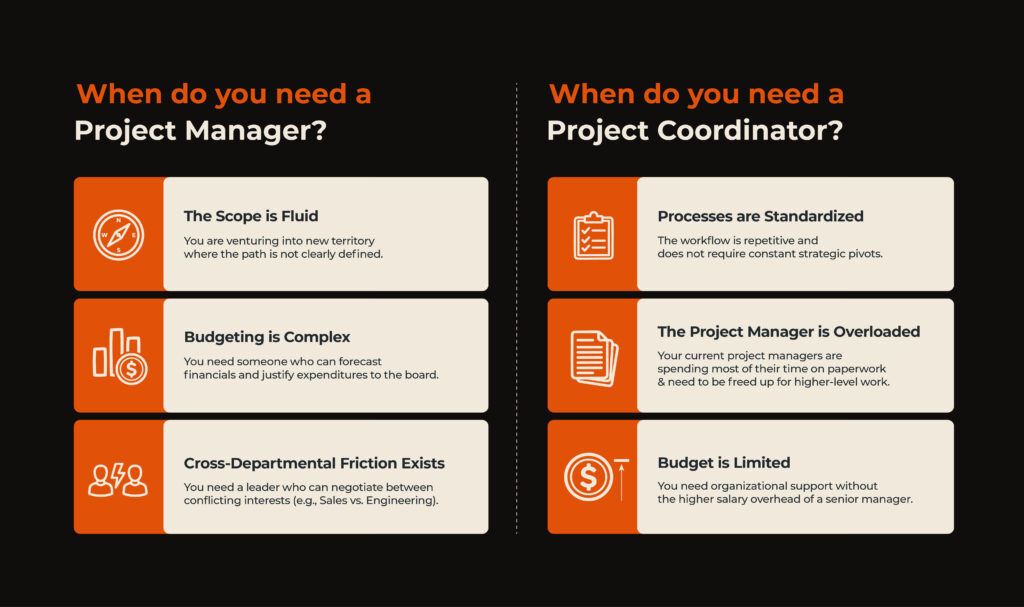
A project manager is essential when:
- The Scope is Fluid – You are venturing into new territory where the path is not clearly defined.
- Budgeting is Complex – You need someone who can forecast financials and justify expenditures to the board.
- Cross-Departmental Friction Exists – You need a leader who can negotiate between conflicting interests (e.g., Sales vs. Engineering).
When Does Your Organization Need a Project Coordinator?
Smaller, more predictable projects often do not require a dedicated project manager. If your roadmap is already set and you need someone to ensure the project runs on time, a project coordinator is the more efficient choice.
Hire a project coordinator when:
- Processes are Standardized – The workflow is repetitive and does not require constant strategic pivots.
- The Project Manager is Overloaded – Your current project managers are spending most of their time on paperwork and need to be freed up for higher-level work.
- Budget is Limited – You need organizational support without the higher salary overhead of a senior manager.
Project Manager and Project Coordinator: When Do You Need Both?
Most growing organizations do not need to choose between a project coordinator vs project manager, as they need both to thrive.
Both roles are necessary when your projects become too complex for a single role to handle without losing clarity, speed, or control. As work scales, responsibilities naturally split between strategy and execution, and having both roles in place helps maintain balance between the two.
This combination is especially valuable when:
- Projects involve multiple teams or departments that need constant coordination.
- Timelines are tight and require both planning and hands-on follow-ups.
- There is a high volume of tasks, updates, and documentation to manage.
- Stakeholder expectations are high and need structured communication.
- The project manager needs more bandwidth to focus on strategy and decision-making.
When both work together, the project manager can focus on direction and outcomes, while the project coordinator ensures day-to-day execution stays organized. This division of responsibility helps reduce bottlenecks, improve accountability, and create a system where nothing is overlooked and everything moves forward.
Also Read: When Should Companies Opt for Project-Based Staffing Services
Common Mistakes to Avoid When Hiring a Project Manager or Coordinator
- Misaligning Role Seniority with Project Complexity – Many organizations over-hire by bringing in a project manager for repetitive, low-risk tasks that a project coordinator could handle more efficiently. This inflates your overhead and often leads to the senior hire feeling underutilized.
- Expecting Tactical Support to Handle Strategic Risk – It is a critical error to ask a coordinator to navigate high-stakes stakeholder negotiations or budget pivots. Without the experience of a project manager, they may lack the authority or foresight needed to steer a project through a crisis.
- Underestimating the Value of Domain Expertise – When a project manager or project coordinator lacks familiarity with the industry, it can slow down the project and make communication less effective. Instead of focusing on execution and coordination, much time is spent simply interpreting terminology and clarifying basic context.
- Overlooking Specialized Staffing Solutions – Relying on generic hiring approaches can lead to a mismatch, even when organizations are careful, because project requirements are often complex, evolving, and not always clearly defined at the start.
As a result, a project manager or project coordinator may be brought in with strong general experience but limited alignment to the specific industry, tools, or workflow expectations of that project. This kind of gap can create execution friction, slow decision-making, increase attrition risk, and ultimately lead to project delays due to lost continuity and repeated ramp-up efforts.
Wrapping Up
The debate around project manager vs project coordinator is not about which role is better; it is about which one fits your needs at a given time. If your organization is dealing with missed deadlines or wasted capital, the solution might be a shift in how you structure your leadership.
At SPECTRAFORCE, we specialize in identifying these nuances, helping you identify, hire, and scale the right talent, fast.
Whether you need a strategic project manager or a detail-driven coordinator, we offer both permanent staffing services and short-term, project-based solutions, bridging the gap between niche talent and organizational demand.
Talk to us and take the next step toward building a team that delivers consistent results.
Frequently Asked Questions
What’s higher in role, project manager or project coordinator?
A project manager holds a higher-level role with greater responsibility, including decision-making authority, budget ownership, and oversight of overall project outcomes. A project coordinator supports the manager and focuses on execution.
Can a project coordinator become a project manager?
Yes, and it is a common career path. As project coordinators gain experience handling day-to-day coordination, working closely with stakeholders, and gradually getting exposure to decision-making, they naturally build the leadership and business understanding needed to move into project management roles.
What is another name for a project coordinator?
Depending on the organization, similar roles may include project assistant, project administrator, or operations coordinator.
Is a coordinator better than a manager?
Neither role is better than the other. They serve different purposes. A project coordinator excels at execution and keeping everything organized day to day, while a project manager focuses on shaping strategy and driving overall outcomes. The right fit really depends on the complexity of your project and what you are trying to achieve.