
Are your hiring teams reaching the right candidates, or just waiting for applications to come in?
According to CIPD’s Resourcing and Talent Planning report, 64% of organizations that attempted to fill vacancies found it difficult to attract candidates. This shows why strong candidate sourcing strategies are now essential for businesses.
Sourcing is not just about posting a job online. It is about finding skilled talent early, engaging passive candidates, and building a pipeline before roles become urgent. With the right sourcing approach, companies can improve hiring speed, candidate quality, and long-term workforce planning.
What is Candidate Sourcing?
Candidate sourcing is the process of actively finding and engaging people who may be a good fit for a role. It happens before a candidate formally applies and often before a hiring team has enough applicants in the pipeline.
Instead of waiting for resumes to come in, recruiters search for suitable talent through job boards, resume databases, LinkedIn, referrals, professional communities, past applicants, and networking platforms.
Understanding how to source candidates is important because many skilled professionals are not actively seeking new jobs. They may already be employed, but are open to the right opportunity if approached with a relevant role. This is why sourcing includes both active job seekers and passive candidates.
A good sourcing process starts with a clear understanding of the role, required skills, experience level, location, pay range, and work model. Recruiters then identify matching profiles, reach out with personalized messages, and begin building interest in the opportunity.
| Note: Candidate sourcing is not the same as final hiring. It is the first step in creating a strong talent pipeline. When done well, it helps businesses improve candidate quality, reduce hiring delays, and stay prepared for current and future workforce needs. |
Candidate Sourcing vs Recruiting: What is the Difference?
Candidate sourcing and recruiting are closely related but not the same. Both functions work together to build a stronger hiring pipeline. Here are some key points of difference between the two:
| Factors | Candidate Sourcing | Recruiting |
| Main Focus | Candidate sourcing focuses on finding qualified people who may fit current or future roles. | Recruiting focuses on managing candidates through the complete hiring process. |
| Timing | Sourcing can begin before a role is open or before applications come in. | Recruiting usually begins when there is an active hiring need. |
| Candidate Type | It includes active job seekers and passive candidates who may not yet be applying. | It includes applicants, referred candidates, and sourced candidates already in the hiring funnel. |
| Primary Goal | The goal is to build a strong and relevant talent pipeline. | The goal is to assess, select, and close the right candidate. |
| Activities Involved | It includes profile search, database mining, outreach, referrals, and talent pool creation. | It includes screening, interview coordination, offer discussions, and hiring follow-ups. |
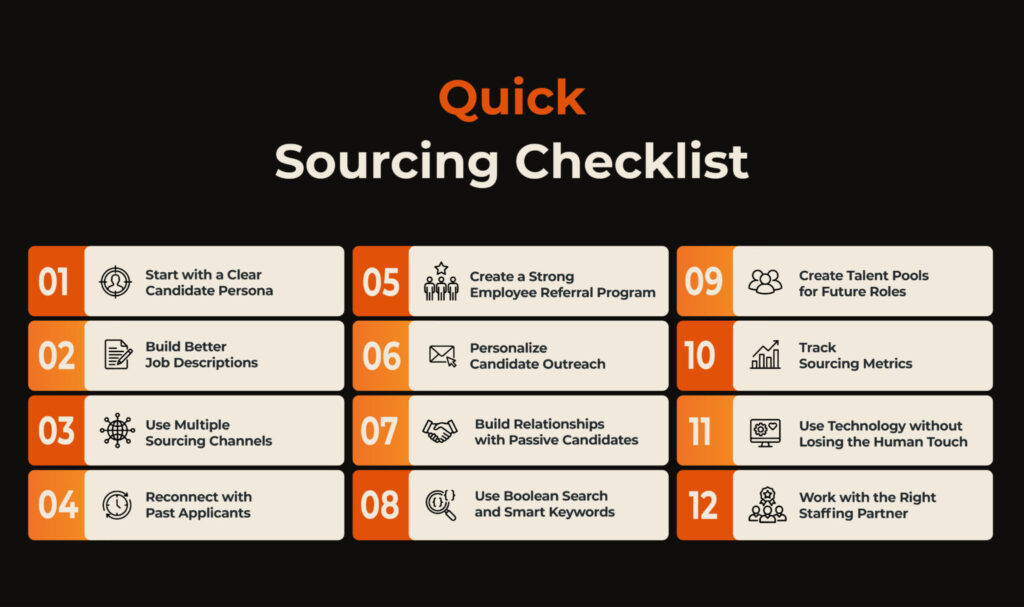
12 Practical Tips for Sourcing Candidates Effectively
Candidate sourcing works best when it is planned, consistent, and focused on quality. Here are 12 practical tips that can help businesses source candidates more effectively.
1. Start with a Clear Candidate Persona
Before starting the search, define the ideal candidate. This should include required skills, years of experience, industry background, location, work model, salary range, certifications, and soft skills.
A clear candidate persona helps recruiters avoid guesswork. It also helps hiring managers and talent teams stay aligned from the beginning.
For example, if a company needs a data analyst, the sourcing team should know whether the role requires SQL, Python, Power BI, Tableau, or industry-specific reporting experience. Without this clarity, recruiters may find many profiles, but very few relevant candidates.
2. Build Better Job Descriptions
A strong job description makes sourcing easier. Candidates need to clearly understand the role, expectations, responsibilities, growth opportunities, and workplace model.
Many job descriptions become too long, too vague, or too demanding. This can discourage qualified candidates from responding. Instead, the job description should separate must-have skills from good-to-have skills. It should also explain what the candidate will actually do in the role.
When recruiters source candidates, they often use the job description to create outreach messages. A clear job description helps them present the opportunity simply and convincingly.
3. Use Multiple Sourcing Channels
One sourcing channel is never enough. Different candidates spend time on different platforms, so businesses need a multi-channel approach.
Recruiters can use job boards, resume databases, LinkedIn, employee referrals, talent communities, alumni networks, social media platforms, industry forums, and professional associations.
Using multiple channels also reduces dependence on a single talent source. If one platform does not deliver enough relevant candidates, recruiters can still find talent through other sources.
4. Reconnect with Past Applicants
Past applicants are often an underused talent source. A candidate who was not right for one role may be perfect for another opening later.
Recruiters should revisit previous applicants, interview finalists, and those who really did well in the past but were not selected or left the job for some reason. These candidates already know the company to some extent, which can make re-engagement easier.
This approach also saves time because the recruiter may already have basic details about the candidate’s skills, experience, and level of interest. However, communication should still be personal and respectful. The candidate should feel valued, not like an old profile pulled from a database.
5. Create a Strong Employee Referral Program
Employee referrals can be one of the most reliable sourcing methods. Employees often know people from previous workplaces, professional groups, college networks, and industry circles.
A good referral program should be simple to use. Employees should know which roles are open, what kind of candidates are needed, and how to submit referrals. Referral rewards, clear communication, and regular updates can also encourage participation.
Referred candidates may be more inclined to trust the opportunity because they hear about it from someone they know. This can improve response rates and candidate confidence.
6. Personalize Candidate Outreach
Generic messages are easy to ignore. Candidates, especially passive candidates, are more likely to respond when the message feels relevant to their experience.
A good outreach message should explain why the candidate is a good fit. It can refer to their current role, skills, projects, industry background, or career path. The message should also be short, clear, and respectful of their time.
Instead of saying, “We have an exciting opportunity,” recruiters can explain why the role is a good fit for that candidate. Personalization shows effort. It also makes the first interaction feel more human.
7. Build Relationships with Passive Candidates
Many strong candidates are not actively looking for a job. They may be employed, comfortable in their current role, or waiting for the right opportunity. These passive candidates need a different approach.
Recruiters should not push them to apply immediately. Instead, the focus should be on starting a conversation. Share useful information about the role, company, career growth, flexibility, team structure, or project scope.
Even if a passive candidate is not ready now, they may become interested later. Building long-term relationships helps companies create a warmer talent pipeline for future hiring needs.
8. Use Boolean Search and Smart Keywords
Boolean search helps recruiters find more accurate profiles by combining keywords with operators like AND, OR, and NOT. This is useful when searching databases, job boards, LinkedIn, and online profiles.
For example, a recruiter sourcing for a software developer may search for “Java AND Spring Boot AND AWS” to find candidates with all three skills. They may also use OR to include similar titles, such as “software engineer OR backend developer OR Java developer.”
Smart keyword usage matters because candidates may describe the same role in different ways. Recruiters should include related job titles, tools, certifications, and industry terms to avoid missing good profiles.
9. Create Talent Pools for Future Roles
Sourcing should not stop once a role is filled. Strong hiring teams continue to build talent pools for recurring and future roles.
Talent pools can be organized by skill, location, seniority, industry, availability, and job type. For example, a company may maintain separate talent pools for IT roles, customer support roles, healthcare positions, finance professionals, or contract workers.
This speeds up future hiring because recruiters do not have to start from scratch every time. However, talent pools must be updated regularly as candidate information, availability, and career interests can change over time.
10. Track Sourcing Metrics
Candidate sourcing improves when recruiters measure what works. Without data, teams may spend too much time on channels that do not deliver quality candidates.
Important sourcing metrics include response rate, source of hire, candidate quality, interview conversion rate, offer acceptance rate, time-to-submit, time-to-fill, and retention by source.
For example, one platform may produce many profiles but very few interview-ready candidates. Another channel may deliver fewer candidates but better matches. Tracking these insights helps businesses invest their sourcing time and budget more effectively.
11. Use Technology Without Losing the Human Touch
Technology can speed up and organize candidate sourcing. AI-enabled tools, applicant tracking systems, candidate relationship management platforms, and automation tools can help recruiters search profiles, match skills, schedule follow-ups, and manage candidate data.
However, technology should support recruiters, not replace judgment. A tool may identify matching keywords, but a human recruiter must still understand motivation, communication style, career goals, and role fit.
Over-automation can also make candidate outreach feel cold. The best sourcing process combines speed with human connection.
Use Technology Without Losing the Human Touch’ — or in the technology section] SPECTRAFORCE’s Leoforce AI combines 70+ sourcing channels with 300+ candidate attributes to surface the strongest matches 50% faster — the kind of precision only a tech-enabled recruitment agency can deliver at scale.
Use Technology Without Losing the Human Touch’ — or in the technology section] SPECTRAFORCE’s Leoforce AI combines 70+ sourcing channels with 300+ candidate attributes to surface the strongest matches 50% faster — the kind of precision only a tech-enabled recruitment agency can deliver at scale.
12. Work with the Right Staffing Partner
Sourcing becomes more challenging when roles are urgent, specialized, high-volume, or spread across different locations. In such cases, working with an experienced staffing partner can help businesses expand their reach and improve hiring efficiency.
A staffing agency can support market mapping, candidate search, screening, pipeline building, and talent engagement — freeing internal teams to focus on interviews, decisions, and long-term workforce strategy.
A Few Common Candidate Sourcing Mistakes to Avoid
Candidate sourcing can bring better results when it is focused, consistent, and backed by a clear hiring plan.
However, a few common mistakes can slow down the process and reduce candidate quality.
-
- Depending on One Sourcing Channel: Relying only on one job board or platform limits reach. Different candidates use different channels, so recruiters should combine job boards, referrals, social platforms, resume databases, and professional networks.
-
- Sending Generic Outreach Messages: A copy-paste message rarely creates interest. Candidates are more likely to respond when the message explains how the role aligns with their skills, experience, or career goals.
-
- Not Updating Talent Pools: Old candidate data can lead to wrong assumptions. Recruiters should regularly update contact details, availability, skills, and job preferences to keep talent pools current.
-
- Overusing Automation: Automation can support sourcing, but it should not replace human judgment. Personal conversations still matter when assessing interest, fit, and long-term potential.
How Technology Can Improve Candidate Sourcing
Technology can make candidate sourcing faster, smarter, and more organized. It helps recruiters search wider talent pools, manage candidate data, and reach the right people with less manual effort.
-
- Faster Profile Matching: AI-enabled tools can scan resumes, match skills to job requirements, and quickly shortlist relevant profiles. This saves time, especially when recruiters are hiring for high-volume or hard-to-fill roles.
-
- Better Talent Pool Management: Applicant Tracking Systems and candidate relationship tools help recruiters store, segment, and update candidate information. This makes it easier to reconnect with past applicants, passive candidates, and people who may be a good fit for future roles.
-
- More Personalized Outreach: Technology can help recruiters organize outreach, schedule follow-ups, and track candidate responses. Still, the message should feel personal. Candidates are more likely to respond when they feel the role is relevant to them.
-
- Clearer Hiring Insights: Recruitment analytics can show which sourcing channels bring better candidates, where drop-offs happen, and how long roles take to fill. These insights help businesses improve their sourcing approach over time.
Technology improves speed and accuracy while recruiters continue to bring judgment, empathy, and relationship-building into the process.
Conclusion
The best candidate sourcing strategies are built around clarity, consistency, and human connection. Businesses need more than job posts to find the right talent. They need strong role planning, multiple sourcing channels, personalized outreach, updated talent pools, and data-backed hiring decisions.
SPECTRAFORCE helps organizations make this process more focused and scalable. With technology-enabled recruitment support, experienced sourcing teams, and a human-led approach, we help businesses connect with qualified candidates across roles, industries, and hiring needs.
Whether the requirement is urgent, specialized, or high-volume, we can support smarter candidate sourcing from the start.
FAQs
Can SPECTRAFORCE help with candidate sourcing for hard-to-fill roles?
Yes. SPECTRAFORCE supports businesses with staffing services across contract staffing, direct hire, and project-based hiring. For hard-to-fill roles, this means companies can access a wider talent network, structured sourcing support, and recruiters who understand role requirements beyond basic keywords. SPECTRAFORCE also uses technology-enabled hiring processes to improve speed and candidate relevance.
Does SPECTRAFORCE use AI in candidate sourcing?
Yes. Leoforce, our AI recruiting partner, strengthens SPECTRAFORCE’s hiring approach. Leoforce combines AI with expert recruiters to find talent faster and more precisely. We have already accomplished: 70+ sourcing channels, 300+ candidate attributes assessed, 50% faster time to submit, and 72% improvement in candidate quality.
What hiring models does SPECTRAFORCE support?
SPECTRAFORCE supports multiple workforce models, including contract staffing, direct hire, project-based hiring, and RPO. This helps businesses choose the right model based on urgency, role type, budget, and long-term workforce goals. For example, direct hire can support permanent roles, while RPO can help organizations manage recruitment at scale.
How does SPECTRAFORCE improve sourcing efficiency?
SPECTRAFORCE improves sourcing efficiency through recruiter expertise, structured hiring processes, AI-enabled sourcing, intelligent matching, and candidate rediscovery. Our RPO services include 24/7 automated sourcing and matching to increase recruiter productivity and accelerate time-to-submit. This helps businesses build stronger pipelines while keeping human review central to final candidate evaluation.