
When dashboards break, and leadership cannot get a straight answer on last quarter’s revenue, the instinct is to hire a data person.
The harder question is which one to hire first, because getting the sequence wrong creates problems that compound the longer they go unaddressed.
The Bureau of Labor Statistics projects that employment in data-related roles will grow 34 percent through 2034, more than ten times the national average.
Getting the data engineer vs data analyst decision right the first time matters more than ever. As competition for this talent intensifies, a mis-hire in the wrong sequence compounds the longer it goes uncorrected. This guide is built to help business leaders make that call with clarity.
What Is the Data Engineer Role?
Every downstream data function, from analytics to AI programs, depends on the infrastructure a data engineer builds and maintains. A data engineer builds and maintains the systems that move data from source applications into a central, reliable location. They design the automated pipelines that ensure every downstream team receives clean, consistent data on schedule.
What your business gets when you hire a data engineer:
- Dashboards that load reliably and show consistent numbers across all teams
- Analysts are freed from spending their day cleaning and reconciling raw data
- A scalable data infrastructure that supports AI and analytics programs as the business grows
- A trusted single source of truth that leadership decisions can be built on
Without a data engineer in place, dashboards produce conflicting numbers, and analysts spend their time on cleanup work that falls well outside their core function.
Also Read: Data Engineering Hiring Trends 2026: Why Talent Is Harder to Find Than Ever
What Is the Data Analyst Role?
A data analyst’s role at its core is to bridge the gap between data infrastructure and business decisions. A data analyst answers business questions using data and translates findings into recommendations that non-technical stakeholders can act on. They build dashboards and reports that surface trends leadership would otherwise miss.
What your business gets when you hire a data analyst:
- Real-time visibility into revenue trends and campaign results
- Opportunities and risks surfaced before they became costly to the business
- Data-informed decisions flow to every level of the organization
- Reporting that business teams can use without needing technical support
Without a data analyst, leadership makes decisions on instinct because the insights locked in your data have no one to surface them.
The Difference Between A Data Engineer Vs Data Analyst In Hiring Terms
The core difference between a data analyst and a data engineer is where each sits in the data value chain. For hiring managers making the data engineer vs data analyst call, this distinction determines which role to open first. Engineers build the infrastructure that analysts depend on to do their work, and without that foundation, even the best analyst cannot produce output that the business can trust.
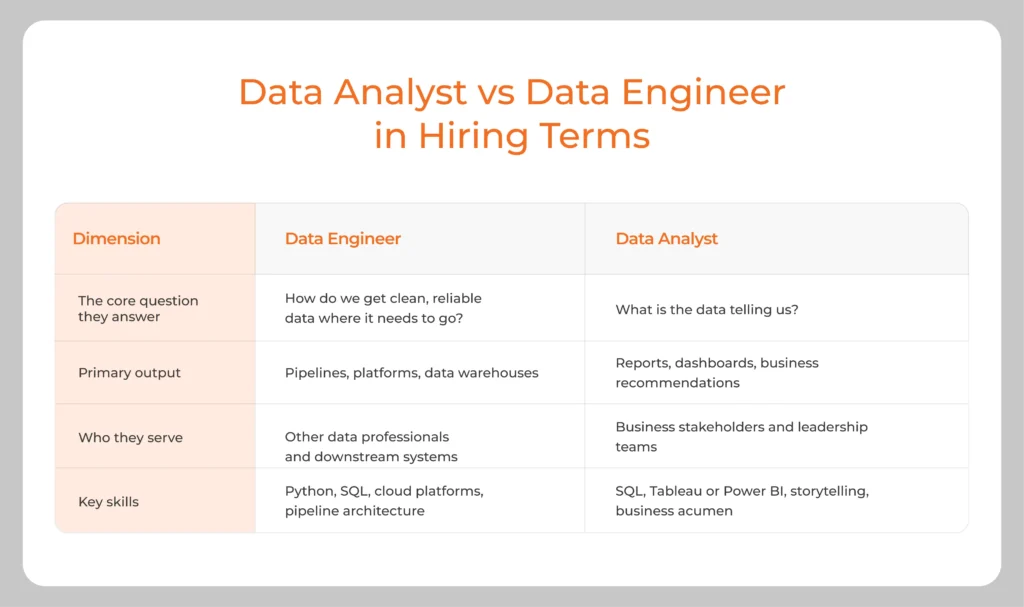
This dependency is critical for hire sequencing because data analysts rely on the infrastructure that data engineers build and maintain. Without reliable pipelines, analyst output cannot be trusted by the business.
Data Engineer vs Data Analyst Salary: What to Budget
The salary gap between these two roles reflects the deeper technical specialization on the engineering side. Compensation benchmarking should be completed before the search begins to avoid losing candidates at the offer stage.
| Role | Average Total Pay | Typical Range |
| Data Engineer | $132,000 | $104,000 – $171,000 |
| Data Analyst | $92,000 | $71,000 – $120,000 |
Source: Glassdoor 2026.
Engineers command a significant salary premium across all seniority levels, reflecting the smaller talent pool and the enabling role they play across the data stack. Compensation benchmarking should be completed before the search begins to avoid losing candidates at the offer stage.
Also Read: What Is Staff Augmentation and When Should Companies Use It?
Data Engineering vs Data Analytics: Which Should You Prioritize First
The data engineer vs data analyst decision is not a debate. It is a sequencing problem driven by your current data setup. Most businesses fall into three stages, and each stage points to a clear first hire.
Hire a data engineer first when:
- Data is spread across multiple systems with no reliable central source
- Analysts spend most of their time on cleanup and reconciliation
- Dashboards produce conflicting numbers or break across departments
- You are building infrastructure for AI or machine learning programs
Hire a data analyst first when:
- Data lives in manageable tools, and off-the-shelf connectors can handle movement
- Leadership needs answers to business questions, and dashboards do not yet exist
- Engineering infrastructure is not yet a constraint for your data complexity
Hire both when:
- Your analyst is building workarounds because the engineering infrastructure is incomplete
- Data volume and business intelligence demands are growing simultaneously
- You are investing in data as a long-term strategic capability
Common Mistakes in Data Engineer Hiring and Data Analyst Hiring
Hiring managers fall into the same traps when filling these roles.
- Writing the wrong job title and attracting candidates with mismatched expectations
- Expecting one person to cover both engineering and analyst functions on an ongoing basis
- Hiring a data scientist before foundational infrastructure is in place
- Overloading the job description with every possible technical skill significantly shrinks the qualified applicant pool
See how SPECTRAFORCE staffed a complex enterprise data hub project to understand what a structured hiring process looks like in practice.
Our AI-powered candidate matching surfaces pre-vetted data professionals who fit both the technical requirements and the team. If you are working through this decision, we are easy to reach.
FAQs
The decision depends on where your organization currently sits in its data maturity journey. If data lives in manageable tools and you need business insights quickly, start with an analyst. If data is fragmented across multiple systems with no reliable pipeline, hire a data engineer first because data analysts cannot produce trustworthy insights from unreliable data.
The most reliable approach is to diagnose the pain point before opening the search. If leadership cannot get answers to business questions, you need an analyst. If your data systems produce conflicting numbers or break regularly, you need an engineer. When both are true, prioritize the engineer because they remove the bottleneck that limits every other data hire.
For data engineers, required skills include Python, SQL, cloud platforms such as Snowflake or Databricks, and pipeline design experience. For data analysts, required skills include SQL, visualization tools such as Tableau or Power BI, communication skills, and genuine business acumen. Both roles demand structured problem-solving and intellectual curiosity.
Working with a specialist staffing agency gives hiring managers access to pre-vetted data candidates who are not reachable through standard job boards. SPECTRAFORCE offers flexible engagement models, including staff augmentation and contract-to-hire, which reduces risk while keeping timelines tight.
Full-time hires make the most sense for ongoing, core data functions where consistency and institutional knowledge matter. For work that is project-based or tied to a specific peak in demand, contract staffing and staff augmentation offer flexibility without the long-term overhead of a permanent hire. Most mature data organizations run both models in parallel, with permanent roles anchoring the strategic core and flexible staffing covering the rest.