
The U.S. hiring market in 2026 will look vastly different from what we know today. With the rapid pace of change in technology, healthcare, and other critical sectors, the demand for talent is shifting at an unprecedented rate. As HR and talent acquisition professionals, it’s essential to understand where these changes are happening and how to adapt.
In this blog , we will explore the industries driving this growth and the roles and skills that will be in high demand.
Top Industries Hiring Fastest in 2026
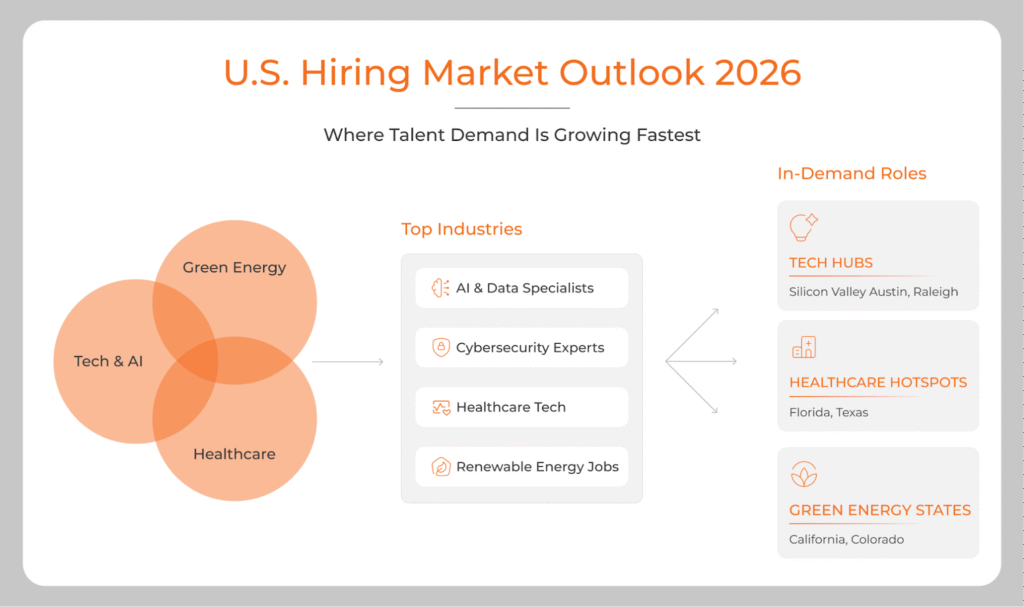
In 2026, the industries set to see the most significant growth are those with their roots already firmly planted in technology and healthcare. These sectors represent the future of work and also offer unparalleled opportunities for HR leaders to focus their workforce strategies.
Tech and AI
The technology sector, driven by advancements in Artificial Intelligence (AI) and Machine Learning (ML), is expected to be one of the largest contributors to job growth. According to projections by the Bureau of Labor Statistics (BLS), tech occupations will grow much faster than the national average. Cloud computing, data analysis, and AI are areas that are constantly evolving and expanding.
Employers are particularly interested in individuals who possess skills in AI and cloud computing. Rather than hiring for a specific role, the goal is to nurture capabilities to drive innovation. As more companies rely on these technologies to improve business operations and stay competitive, demand for AI talent will only grow. AI/ML specialists and data engineers are at the forefront of this shift, while cybersecurity experts will continue to be indispensable to ensure the safety and privacy of business data.
Also read: How AI Is Reshaping US Talent Hubs and Changing the Hiring Landscape
Healthcare
Healthcare has always been an essential sector, but it is becoming even more critical as the population ages and demand for medical services rises. As such, healthcare professions such as nurses, medical technicians, and healthcare administrators will see robust growth. In fact, healthcare is expected to be the largest single contributor to job growth in the U.S., particularly amid a national shortage of workers in this field.
However, the demand isn’t limited to traditional healthcare roles. Health tech professionals, skilled in software development for healthcare systems and AI-driven medical solutions, will also experience increased demand. For example, those who can develop AI applications to improve patient care and management systems will find themselves at the intersection of healthcare and technology, with unparalleled career opportunities.
Green Energy
In 2026, the green energy sector will continue its impressive growth. As more businesses and governments push for sustainability, renewable energy roles will see a surge. Solar energy technicians, wind energy engineers, and professionals skilled in sustainable building design will be needed in the growing green energy field. Companies looking to meet their sustainability goals will be actively hiring for these positions.
This sector has both a global and local impact, creating jobs that contribute to environmental sustainability while offering high-demand skills. If you’re targeting this space, focusing on hiring professionals with expertise in clean technologies will be essential.
In-Demand Roles and Skills Employers Are Prioritizing
While certain industries will see rapid growth, it’s the specific roles and skills that will drive the market forward in 2026. The skills that were in demand last year might not be enough to meet future challenges. Here are the roles and skills employers will prioritize in the near future.
AI and Data-Related Roles
In the 2026 workforce, AI optimization engineers and data scientists will be essential. Roles that focus on AI-driven decision-making, predictive analytics, and automation will be in high demand. Employers will look for candidates who can work with AI tools and also develop and refine algorithms that power AI solutions.
Skills in cloud computing and machine learning will be highly sought after. Roles in this area will focus on building infrastructure and deploying real-time analytics pipelines that inform automation logic and enterprise-scale optimization.
Cybersecurity
As businesses continue to digitize, cybersecurity will remain a top priority for employers. The skills in demand in cybersecurity in 2026 will include areas like ethical hacking, penetration testing, and cloud security expertise. With cyber threats evolving constantly, businesses will need professionals who can anticipate risks and protect systems from increasingly sophisticated attacks.
Healthcare Tech and Data Specialists
Beyond traditional healthcare roles, companies will need healthcare data analysts and professionals who can bridge the gap between technology and healthcare. The skills-based hiring model will dominate this space, as employers will look for people who can bring both technical know-how and industry-specific knowledge to the table.
Telehealth and digital health solutions will continue to grow, requiring experts to develop and maintain these platforms. The rise of wearable health tech and AI-powered diagnostic tools will increase demand for professionals who can work at the intersection of healthcare and technology.
Also read: RPO for Healthcare: Solving Compliance and Talent Shortages Together
Regional Talent Demand – Where Jobs Are Growing Fastest
The rise in talent demand is unevenly spread across the U.S. Some regions will see significantly higher growth, and understanding where these job opportunities are concentrated is crucial.
The Tech Hubs
Traditionally, places like Silicon Valley and Seattle have been at the heart of the tech boom. However, cities like Austin, Texas, and Raleigh, North Carolina, are now emerging as key hubs for tech talent. Remote work has also helped disperse talent more widely, with many tech workers choosing to live outside of high-cost cities while still contributing to major companies.
Healthcare Hotspots
The demand for healthcare workers is especially high in rural and underserved areas, where healthcare facilities often struggle to meet community needs. States like Florida and Texas, with rapidly growing populations, will be hot spots for healthcare hiring.
Green Energy States
States like California, Texas, and Colorado are leading the charge in the green energy revolution. These areas are attracting talent that can support sustainable initiatives and innovations in renewable energy.
Also read: Is Toronto’s Climate Tech Boom Creating the Next Wave of Workforce Opportunities?
What This Means for Employers
For employers, the shifting hiring landscape means they must adopt forward-looking strategies to attract the right talent. Traditional recruiting methods will no longer be enough, and companies will need to embrace skills-based hiring to source candidates with the right technical and industry-specific expertise.
In 2026, the emphasis on skills-first hiring will be more prominent than ever. Employers are beginning to prioritize skills over formal education or previous job titles. This will require talent acquisition teams to rethink their hiring criteria and focus on assessing the actual competencies candidates bring to the table.
Conclusion: Staying Competitive in 2026’s Hiring Market
As we move toward 2026, the hiring landscape will demand a much more strategic approach. Employers will need to build adaptable talent acquisition strategies that can pivot quickly to meet changing demands. Companies that focus on cultivating a diverse talent pool, embracing remote and hybrid work models, and prioritizing skills-based hiring will remain competitive in this fast-evolving market.
For HR leaders and talent acquisition teams, the time to act is now. Building a hiring strategy that aligns with these demands will ensure growth and also position your organization as a leader in the future of work.
Is your organization prepared for the talent demands of 2026? At SPECTRAFORCE, we provide strategic talent solutions to meet the evolving needs of industries such as tech, healthcare, and cybersecurity. With our expertise in skills-based hiring and talent acquisition, we ensure you get the right people in the right roles. Explore how our customized staffing solutions can help you build a future-ready workforce.
FAQs
The industries expected to hire the most in 2026 are tech, healthcare, and green energy. These sectors are growing rapidly and will dominate the hiring landscape.
Roles in AI, cybersecurity, healthcare tech, and green energy will be in the highest demand, driven by advancements in technology and sustainability.
The skills-first movement is shifting focus from traditional degrees to practical skills. Employers will prioritize competencies over educational backgrounds, making it easier for talent with non-traditional qualifications to enter the workforce.
Remote and hybrid work have expanded the talent pool, allowing companies to hire from a broader geographic range, especially in tech and healthcare industries, where remote work is more feasible.
Companies can stay competitive by adopting skills-based hiring, offering remote and hybrid work options, and developing skills relevant to emerging technologies like AI and cybersecurity.