
Cybersecurity hiring trends in 2026 are revealing a structural shift in how enterprises define risk capability. For years, hiring demand revolved around perimeter defense, network monitoring, and reactive incident response. That model is now under strain. Cloud architecture has dissolved traditional boundaries. Identity has replaced location as the control point. Fraud has become algorithmic and real-time.
The result is a cybersecurity workforce shortage that is no longer about volume but specialization, integration, and architectural thinking.
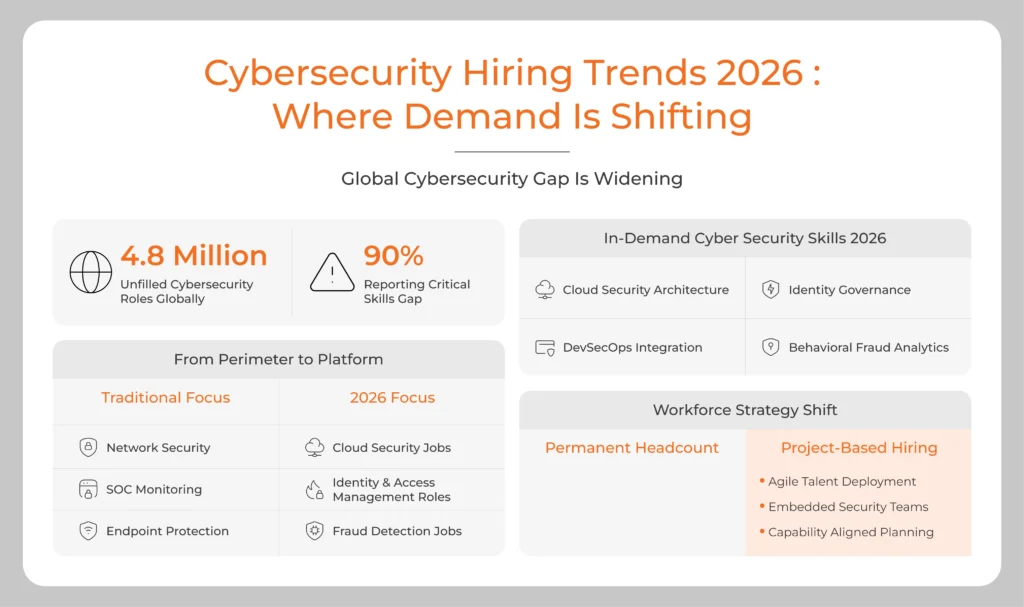
According to the ISC2 2025 Cybersecurity Workforce Study, the global cybersecurity workforce gap now stands at approximately 4.8 million unfilled positions, with nearly 90 percent of organizations reporting critical skills shortages in areas such as cloud and AI security. The shortage is measurable, and it is widening precisely where technical depth is most required.
For CISOs and workforce strategy leaders, the conversation has moved from “How many analysts do we need?” to “Do we have the right security capability embedded into our digital roadmap?” That distinction is shaping cybersecurity hiring trends more than any macro statistic.
Also read: From Overgrowth to Optimization: What the Tech Reset Means for Strategic Hiring
Why Traditional Cyber Hiring Models Are Breaking Down
The current cybersecurity talent shortage is a misalignment of capabilities.
Many enterprises built teams optimized for:
- Network security operations
- Endpoint management
- Centralized SOC monitoring
- Compliance-driven audit controls
Those roles still matter. But they no longer represent the fastest-growing attack surfaces.
Cloud migration, API ecosystems, identity sprawl, and embedded finance have changed the nature of exposure. Yet hiring cybersecurity professionals often still follows legacy job descriptions designed around infrastructure that no longer exists.
The gap is widening, interview cycles are lengthening, offer acceptance is declining, and the cybersecurity hiring challenges are becoming more acute in regulated industries.
The market is signaling that perimeter-era hiring logic cannot solve cloud-native risk.
Cloud Security Is Now an Architectural Hiring Priority
Cloud security jobs are foundational to digital execution.
When enterprises shift workloads to multi-cloud environments, security moves from being a downstream control function to an architectural constraint. DevSecOps engineers, cloud security architects, and container security specialists are shaping how products are built and defended.
This has changed cybersecurity skills in demand in 2026 in three important ways.
First, the technical stack has evolved. Infrastructure-as-code security reviews and CI/CD pipeline integration now sit alongside threat detection.
Second, collaboration expectations are higher. Cloud security professionals must speak the language of engineering and product teams.
Third, speed matters. Release cycles cannot stall due to manual security bottlenecks.
Enterprises in the SaaS and fintech sectors are discovering that their cybersecurity workforce shortage intensifies precisely at the intersection of cloud and product development. Hiring managers are now looking beyond certifications and assessing architectural fluency.
Also read: How AI Spending Is Shaping Tech Hiring Trends for 2026
Identity Is the New Control Plane
In 2026, identity and access management roles are growing faster than many traditional security functions. The reason is structural.
Zero trust frameworks, hybrid work environments, and third-party integrations have turned identity into the new perimeter. Privileged access, federated identity systems, and behavioral authentication are now core controls.
Identity and access management roles now require:
- Deep familiarity with multi-factor authentication systems
- Understanding of identity governance and lifecycle automation
- Experience aligning IAM with regulatory requirements
The expansion of identity-based risk explains why cybersecurity hiring trends show strong demand for IAM architects and access governance specialists. In BFSI and healthcare environments, identity failures directly lead to regulatory exposure.
The hiring challenge here is subtle. Many professionals understand authentication tools. Fewer understand how identity integrates into enterprise architecture. That nuance is where the cybersecurity talent shortage is most visible.
Fraud Risk Is Blurring Security and Financial Controls
Fraud detection jobs are increasingly embedded within cybersecurity teams rather than isolated in risk departments. Digital payments, embedded finance, and real-time transaction systems have merged financial risk with cyber exposure.
In fintech environments, fraud analytics professionals are expected to understand both threat vectors and financial loss modeling. Behavioral anomaly detection now intersects with machine learning pipelines and payment gateway integrations.
This convergence is influencing cybersecurity skills in demand in 2026. Fraud specialists with experience in AI-driven detection are commanding premium compensation. Enterprises are also exploring project-based models for fraud system implementation.
Here, cybersecurity hiring challenges often stem from hybrid skill requirements. Data science capability combined with regulatory literacy is rare. The cybersecurity workforce shortage is particularly acute in fraud roles because the talent pool spans multiple disciplines.
Also read: Global Workforce Compliance & Risk Management for Enterprise Hiring Programs
The Rise of Flexible Hiring Models
Are companies hiring contract or project-based cybersecurity talent more often? The short answer is yes. Project-based hiring is gaining spotlight.
As cloud migrations and identity modernization initiatives accelerate, enterprises are increasingly hiring cybersecurity professionals on a project basis. Implementation waves require intense bursts of specialized skill. Maintaining that capability permanently on payroll may not be economically rational.
In regulated industries, especially BFSI and healthcare, leaders are experimenting with blended workforce models. Core architectural roles remain internal. Specialized expertise for cloud security or fraud system deployment is sourced through project-based engagements.
This shift reflects a deeper recognition within cybersecurity hiring trends. Capability must align with transformation phases. Static hiring plans are giving way to modular workforce design.
Why Cybersecurity Talent Is Harder to Hire in 2026
The cybersecurity talent shortage is compounded by three forces.
Specialization depth has increased. A cloud security architect today must understand Kubernetes, container runtime security, identity integration, and regulatory compliance.
Market competition has intensified. Cloud-first enterprises and SaaS platforms are competing directly with financial institutions for the same talent.
Hiring processes have not evolved quickly enough. Extended interview loops and rigid compensation bands are misaligned with market speed.
In many cases, cybersecurity hiring challenges are self-inflicted. Enterprises underestimate the architectural impact of these roles and treat them as operational hires. That perception gap affects both candidate attraction and internal prioritization.
Strategic Implications for Workforce Leaders
Cybersecurity hiring trends in 2026 point to a structural shift. Workforce strategy now needs to move alongside digital execution.
Cloud transformation programs reshape risk at the architecture level. Cloud security jobs, therefore, need to be embedded within engineering teams and product development cycles. Security capability has to influence design decisions early, because retrofitting controls slows release velocity and increases remediation cost.
Identity expansion across partners, vendors, contractors, and customers has also altered the control landscape. Identity and access management roles now sit at the center of governance, regulatory exposure, and operational resilience. These roles require ownership across systems, not narrow tool-level administration.
Digital transaction growth adds another dimension. Fraud detection jobs increasingly intersect with cybersecurity analytics, machine learning pipelines, and real-time monitoring frameworks. Financial risk and cyber risk are operating within the same data streams. Workforce design needs to reflect that convergence.
The cybersecurity workforce shortage cannot be addressed through incremental increases in requisitions. The underlying issue is capability alignment. Enterprises need to map where cloud, identity, and fraud exposures sit within their operating model and then build hiring plans around those risk layers.
When hiring plans are tied directly to transformation roadmaps, execution friction decreases, recruitment timelines stabilize, and skill deployment becomes intentional rather than reactive. Over time, that alignment compounds into stronger institutional resilience.
Conclusion: From Role-Based Hiring to Capability Architecture
Cloud architecture, identity governance, and fraud analytics now operate within the same ecosystem. Security capability must be designed accordingly. Organizations that embed cybersecurity expertise directly into transformation programs gain faster execution, clearer ownership, and stronger long-term resilience.
Capability architecture brings discipline to workforce planning. Roles are defined by where risk sits within the business model. Hiring becomes intentional, sequenced, and aligned with platform priorities.
This shift represents a redefinition of how enterprises build security depth in a cloud-first, identity-driven economy.
At SPECTRAFORCE, we partner with enterprise leaders to design cybersecurity talent strategies that align with transformation roadmaps. From cloud security jobs to identity and access management roles to fraud detection jobs, we help organizations address today’s workforce challenges while equipping them with the opportunities of tomorrow.
FAQs
Cybersecurity talent is harder to hire in 2026 because specialization depth has increased, cloud-native architectures require integrated expertise, and hiring processes have not kept pace with market competition.
The cybersecurity roles most in demand today include cloud security architects, DevSecOps engineers, identity and access management roles, and fraud analytics specialists embedded within cybersecurity teams.
Cloud adoption is changing cybersecurity hiring needs by shifting demand toward cloud security jobs that integrate directly into engineering workflows and architectural decision-making.
Identity and access management roles are growing so fast because zero-trust frameworks and hybrid work models have made identity the primary control point in enterprise security.
Companies are increasingly hiring contract or project-based cybersecurity talent to address specialized cloud migrations, identity modernization projects, and fraud system implementations without permanently expanding headcount.