
Staffing models may be misunderstood as mere operational frameworks, but they are the backbone of how businesses meet their goals, adapt to change, and stay competitive. Also, there are different models for different scenarios. The way an organization structures its workforce is deeply influenced by industry-specific challenges, regulatory constraints, and the unique needs of its workforce.
From healthcare to tech, financial services, and beyond, staffing strategies vary significantly to address these nuances. This blog explores how different industries craft staffing models that align with their objectives and tackle their unique hurdles.
The Art and Science of Staffing Models
Before diving into industry specifics, it’s important to recognize that staffing models evolve with changes in technology, business needs, and global trends. Whether you’re hiring for a multinational organization or a rapidly growing tech startup, the model you select determines how quickly and efficiently you can deploy talent in the right roles.
Staffing models can be categorized in various ways: from permanent, full-time roles to contingent or contract positions, each offering unique advantages and constraints. The key to success lies in understanding which model aligns best with the company’s goals, the industry landscape, and compliance requirements.
Healthcare Staffing: A Complex Web of Compliance and Expertise
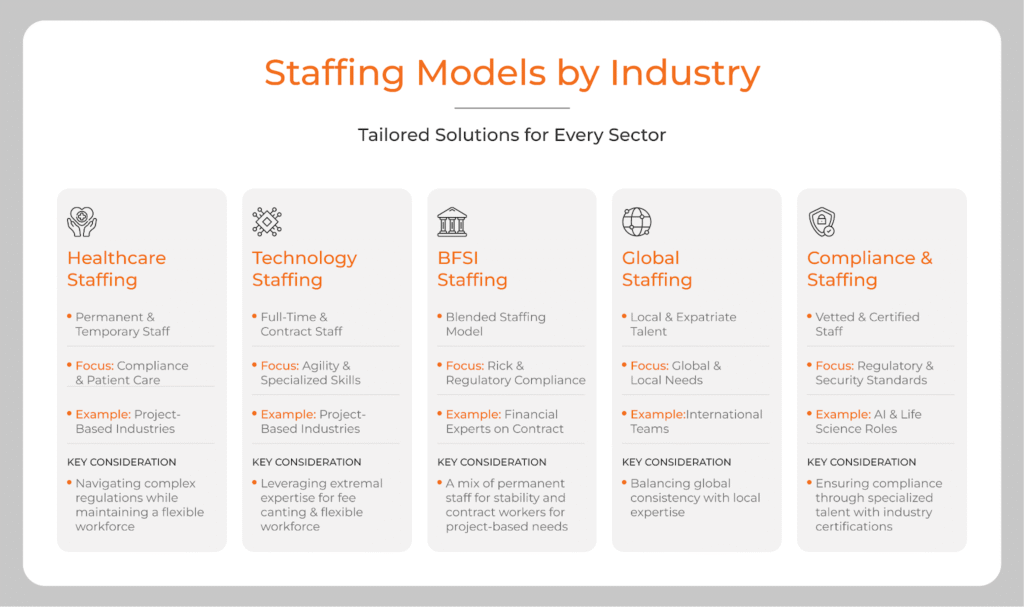
The healthcare industry is a prime example of how staffing models must adapt to a highly regulated, resource-constrained environment. Healthcare organizations typically rely on a blend of full-time, part-time, and temporary staff to manage fluctuations in patient demand, regulatory requirements, and clinical expertise. One of the primary challenges in healthcare staffing is compliance. Whether it’s HIPAA in the U.S. or other country-specific laws, healthcare providers must ensure that all staff are properly trained and certified.
For instance, many healthcare providers adopt a project-based staffing model for specific initiatives such as the setup of new facilities or the launch of specialized care units. This model allows healthcare organizations to bring in temporary, highly specialized talent for a defined period. Project-based staffing models are particularly useful in managing peak periods or addressing sudden changes in patient volumes.
A project-based staffing model can be particularly effective when organizations need specialized skills for a defined timeframe, such as during a product launch or a critical seasonal demand.
Also read: RPO for Healthcare: Solving Compliance and Talent Shortages Together
Technology Staffing: Flexibility to Adapt in an Ever-Changing Landscape
Technology staffing models are often more fluid, designed to adapt quickly to innovation and the constant evolution of software, tools, and methodologies. In the fast-paced world of tech, organizations need talent acquisition models that prioritize agility. For instance, IT staffing models often incorporate both permanent and contingent staff. This hybrid approach ensures that companies have a core team for long-term projects, while also leveraging external talent to address specific, time-sensitive needs.
The scalability of tech staffing models is critical, especially when launching a new product or entering a new market. Technology firms may lean heavily on contract or freelance developers to fill gaps in expertise or speed up development. The benefit of this model is that it enables firms to bring in high-level expertise without the long-term commitment of full-time hiring.
For example, some companies in the tech industry opt for a flexible staffing model by leveraging freelance developers for specific coding projects or new features. This enables them to meet tight deadlines while maintaining operational focus on long-term development goals.
BFSI: Risk Management and Specialized Talent Demand
In the Banking, Financial Services, and Insurance (BFSI) sector, staffing models are often driven by regulatory compliance, data security concerns, and the need for highly specialized talent. With financial regulations constantly evolving, BFSI companies must be prepared to scale their workforce while ensuring compliance with local and international laws. This is where financial services staffing models come into play.
Organizations in the BFSI sector commonly adopt a blended staffing model. This combines permanent hires for long-term stability with contract workers for project-based roles. For instance, in the life sciences sector, staffing needs may include experts for regulatory compliance, technology implementation, and risk management on a temporary basis.
BFSI firms may also engage specialized professionals on a contract basis to ensure that their teams are equipped to manage projects such as regulatory audits or the implementation of new technologies. This approach helps them remain agile while staying compliant.
Global Staffing Models: Adapting Across Borders
One of the most significant challenges in global staffing is the balance between standardization and localization. Multinational corporations often find it necessary to adjust their staffing models based on the region or country in which they operate. For example, a global staffing model may include both local hires and expatriates, depending on the expertise required and local labor market conditions.
Global staffing models are often implemented by large multinational companies that operate across multiple countries. These models enable companies to balance global consistency with local responsiveness, ensuring that leadership roles are filled by experienced expatriates while operational teams are often made up of local talent who understand regional needs.
In some cases, organizations choose to recruit locally for operational positions but hire internationally for leadership or specialized roles. This helps to manage costs while ensuring high-quality management and expertise.
Compliance and Staffing: The Unseen Influence
In every industry, compliance plays a pivotal role in shaping staffing models. In heavily regulated industries like healthcare and BFSI, staffing decisions must account for local laws regarding working hours, wages, and certifications. Similarly, data security requirements in the tech sector often dictate the need for specialized, vetted talent.
For instance, in industries such as IT and BFSI, organizations often implement stringent vetting processes and ensure that staff members have specific certifications to meet industry standards. These regulations influence the choice of staffing models, often leading to the use of highly qualified temporary or contract workers who possess the required certifications.
Workforce compliance, particularly in IT security and financial regulations, often necessitates hiring individuals with highly specialized skills. Staffing models must be adapted to meet these demands without compromising on quality or legal obligations.
Conclusion: The Future of Staffing Models
As industries continue to evolve and face new challenges, the future of staffing models will be increasingly influenced by flexibility, technology, and compliance. AI staffing is gaining traction, helping organizations predict future workforce needs and streamline hiring processes through predictive analytics.
Moreover, the demand for project-based staffing will only grow as businesses seek to remain agile in a competitive environment. Project-based staffing offers the flexibility to scale up or down based on project cycles, ensuring that companies don’t face overstaffing during slow periods or understaffing during growth phases.
Looking ahead, organizations must remain agile in their staffing strategies. The hybrid models that blend permanent, contingent, and project-based roles will become increasingly popular, as businesses need to respond to ever-changing market conditions and technological disruptions.
Ultimately, no matter the industry, organizations need to carefully consider the nuances of staffing models in light of their unique challenges. Whether it’s the compliance-heavy world of BFSI, the ever-evolving tech industry, or the high-stakes environment of healthcare, staffing models will continue to adapt, evolve, and ultimately, shape the future of work.
Discover the ideal staffing model for your industry. Whether you’re navigating healthcare, tech, or BFSI, SPECTRAFORCE’s expert solutions are designed to enhance efficiency, ensure compliance, and drive growth. Connect with us to learn how we can support your staffing needs.
FAQs
The most common staffing model used in healthcare is a blend of permanent and temporary staff. This allows healthcare organizations to maintain a core team of professionals while bringing in specialized talent during peak times.
IT staffing models differ from traditional staffing in their emphasis on flexibility. Technology companies often rely on a combination of full-time employees and contractors to meet evolving project demands and technological advancements.
Industries such as construction, IT, and healthcare often use project-based staffing models to manage fluctuating demand and specialized needs, allowing businesses to scale their workforce based on specific project timelines.
Compliance requirements influence staffing strategies by dictating the necessary qualifications, certifications, and vetting processes for employees. Industries like healthcare and BFSI often rely on temporary or specialized staff to meet these requirements.
A blended staffing model works best for financial services and risk-driven industries, combining permanent hires for stability with contract professionals who provide expertise for time-sensitive projects such as audits or regulatory compliance.