
Enterprise workforce leaders are operating in a different risk environment than they were even three years ago. Delivery models that once optimized for scale and cost are now being stress-tested by regulatory shifts, compressed transformation cycles, data localization mandates, and distributed leadership structures. Global talent is still essential. The operating assumptions around how it is structured have changed.
In this environment, global workforce resilience has become a board-level metric. Execution delays carry regulatory exposure. Misaligned time zones slow product cycles. Fragmented oversight increases compliance friction. The conversation in executive forums has moved beyond labor arbitrage toward structural durability. Leaders are asking how their distributed workforce strategy can sustain velocity without expanding governance risk.
Nearshoring is increasingly central to that recalibration. Enterprise nearshoring is being deployed not as a reaction to geopolitics but as a deliberate workforce architecture decision. By positioning nearshore talent within time-aligned and regulatory-compatible regions, organizations are tightening feedback loops, increasing delivery transparency, and strengthening operational control. What began as a cost efficiency lever has matured into a nearshoring strategy designed to balance speed, oversight, and execution certainty.
This article examines nearshoring as a workforce execution model in 2026. The lens is grounded in how enterprise nearshoring supports resilience across complex, regulated, and globally distributed organizations.
The Enterprise Resilience Imperative
Over the past five years, enterprises have faced synchronized pressures: regulatory scrutiny, distributed team fatigue, data sovereignty requirements, and compressed transformation timelines. Traditional offshore models delivered scale. They did not always deliver agility.
When time zones stretch too far, governance slows. When regulatory environments diverge sharply, compliance overhead increases. When leadership’s visibility into delivery weakens, risk compounds quietly.
Global workforce resilience now requires structural proximity. That is where nearshore talent is entering the conversation.
The business impact of resilience is measurable. According to McKinsey & Company’s State of Organizations research, companies with strong resilience characteristics are more than 40 percent less likely to fail during periods of systemic disruption. For enterprise leaders, this reframes workforce architecture decisions from operational preferences to a risk-management discipline.
For CHROs and CIOs, the question now is how to rebalance global delivery to control execution risk while velocity improves.
What Nearshoring Means in 2026
Nearshoring is often reduced to geography. That framing is incomplete.
In 2026, nearshoring refers to the deliberate placement of delivery teams in adjacent or time-aligned regions to optimize:
- Governance oversight
- Cultural alignment
- Regulatory compatibility
- Real-time collaboration
A nearshoring strategy is therefore a workforce architecture decision. It determines where core capabilities sit relative to leadership, customers, and compliance frameworks.
For North American enterprises, nearshoring LatAm has become central to distributed workforce strategy. For Western European firms, Eastern Europe and Mediterranean markets play a similar role. The logic is consistent. Proximity increases transparency. Transparency improves control.
Nearshoring vs Offshoring: A Structural Shift
The debate between nearshoring and offshoring is often framed around cost differentials. That is a narrow view.
Offshore staffing optimized for scale and cost efficiency. Nearshore staffing solutions optimize for execution stability.
Consider a regulated financial services enterprise launching a digital payments platform. The transformation window is 12 months. Regulatory requirements evolve mid-program. Engineering, compliance, and product leaders need daily alignment. In this context, time-zone overlap and regulatory familiarity materially affect delivery outcomes.
Nearshore delivery teams enable synchronous collaboration. Risk escalations are resolved in hours, not days. That difference compounds over program lifecycles.
Nearshoring services are therefore being selected for mission-critical capabilities, particularly where governance exposure is high.
Also read: How U.S. Employers Are Rebalancing Their Workforce With Onshore, Nearshore, and Offshore Talent
Where Nearshoring Creates the Most Enterprise Value
Not every function requires proximity. The strategic application matters.
In 2026, enterprises are prioritizing nearshore IT staffing and nearshore teams for:
- Cloud modernization and DevOps
- Cybersecurity operations
- Data engineering and analytics
- Digital product development
- Regulatory technology integration
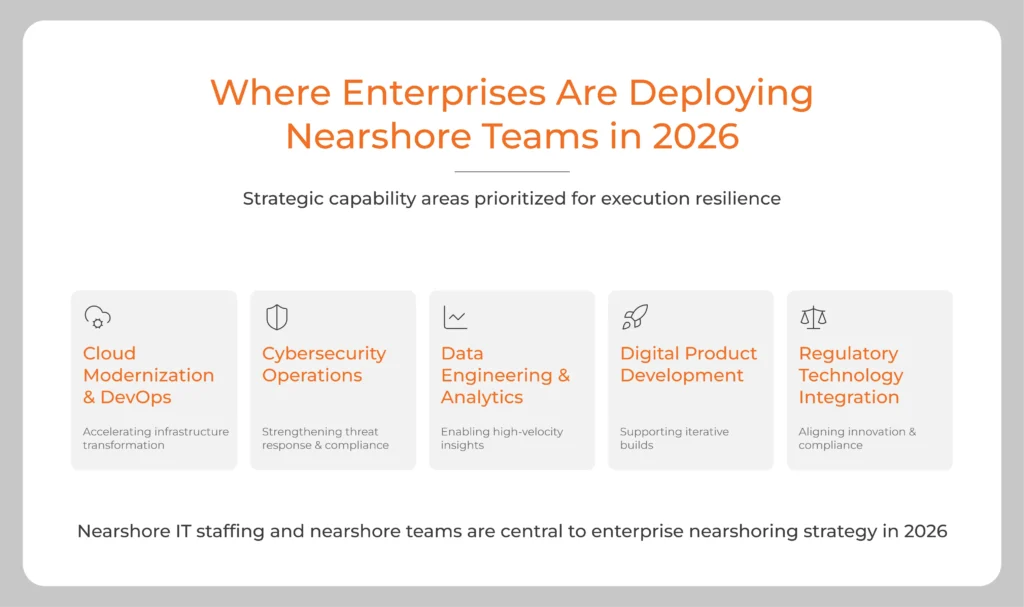
These functions are closely related to enterprise risk. They demand rapid iteration and stakeholder alignment. Nearshore outsourcing services support this model by combining technical depth with operational transparency.
Enterprise nearshoring is also being deployed within global capability centers to support hybrid leadership models. Senior architects may remain in headquarters markets while build teams operate in aligned regions. The overlap reduces friction without compromising scalability.
Also read: Nearshoring for Tech: Solving Talent Shortages + Time Zone Headaches
Governance, Compliance, and Control
For procurement and risk leaders, the strongest case for a nearshoring strategy lies in compliance architecture.
Cross-border regulatory complexity has increased. Data protection laws, financial oversight standards, and sector-specific mandates vary widely. When delivery teams operate within aligned regulatory frameworks, compliance harmonization becomes manageable.
Nearshore staffing solutions allow enterprises to:
- Align with similar legal standards
- Reduce data transfer friction
- Maintain audit visibility
- Accelerate remediation cycles
This is particularly relevant for regulated and global organizations operating in healthcare, banking, and critical infrastructure.
Global workforce resilience depends on predictable governance. Predictability lowers systemic risk.
Cost Dynamics: A Long-Term View
Is nearshoring more expensive than traditional offshore models? In hourly rate comparisons, often yes. In total program economics, the answer is more nuanced.
Cost must be evaluated across:
- Delay risk
- Rework cycles
- Compliance penalties
- Leadership bandwidth
- Customer impact
A nearshoring strategy that reduces iteration loops and accelerates decision-making frequently lowers the total cost of ownership over multi-year programs.
Enterprises increasingly evaluate nearshore vs offshore staffing through the lens of execution certainty rather than labor rates alone.
Nearshoring and Distributed Workforce Strategy
Hybrid work has permanently altered enterprise operating models. Distributed workforce strategy now extends across continents.
Nearshore teams integrate more seamlessly into hybrid environments because leadership time-zone alignment enables shared rituals. Sprint reviews, design workshops, and compliance audits occur within overlapping business hours. Communication becomes iterative instead of transactional.
Nearshore talent also supports succession planning. Leadership pipelines can extend into adjacent regions without severe cultural dislocation. This creates structural continuity.
Nearshoring is therefore functioning as an anchor within a distributed workforce strategy, stabilizing global execution while preserving flexibility.
The Bottom Line
Enterprises that treat nearshoring as a tactical staffing adjustment will capture incremental gains. Those that embed nearshoring into enterprise workforce strategy will create structural optionality.
Optionality matters. Regulatory environments will continue to shift. Technology cycles will compress further. Political landscapes will remain unpredictable. Organizations with geographically balanced delivery architectures can rebalance faster.
One overlooked advantage of enterprise nearshoring is leadership development. Proximate regions often serve as testbeds for emerging global leaders. The combination of cultural familiarity and operational exposure accelerates executive readiness. Over time, this builds a more globally fluent leadership bench.
Another strategic gain lies in ecosystem partnerships. Nearshore regions often foster stronger vendor collaboration due to proximity and shared time zones. Joint innovation initiatives become feasible. That collaboration layer deepens resilience.
In 2026, resilience is less about absorbing shocks and more about sustaining momentum during uncertainty. Nearshoring strategy enables that momentum. It tightens feedback loops, strengthens governance, and increases execution clarity.
Enterprises that are rebalancing toward nearshore delivery teams are not retreating from globalization. They are refining it. And refinement, in volatile environments, becomes a competitive advantage.
At SPECTRAFORCE, we help large and regulated organizations build resilient nearshore teams that strengthen execution, improve compliance visibility, and support long-term global workforce resilience. From nearshore IT staffing to fully managed nearshore delivery teams, our models are designed for control, scalability, and measurable outcomes.
FAQs
Nearshoring differs from offshoring in its structural proximity, enabling greater time-zone overlap, regulatory alignment, and governance visibility, which are critical for enterprise delivery stability.
Nearshoring is considered a lower-risk talent model because it improves oversight, reduces compliance friction, and accelerates issue resolution through closer operational alignment.
The functions best suited for nearshoring in 2026 include cloud modernization, cybersecurity, data engineering, digital product development, and regulatory technology integration.
Nearshoring supports hybrid and distributed teams by enabling synchronous collaboration, leadership integration, and smoother coordination across shared business hours.
Nearshoring may have higher hourly rates, but long-term economics often improve due to reduced delays, fewer compliance risks, and stronger execution predictability.