Over the past few years, workforce planning has become significantly more complex. Economic cycles are shorter. Revenue visibility is less predictable. Regulatory oversight is tightening across industries. At the same time, digital transformation programs continue to demand highly specialized skills at speed.
In this environment, hiring decisions carry more weight than they once did. They influence cost structures, operational resilience, delivery timelines, and even investor confidence. What may appear to be a simple staffing choice can quietly reshape how exposed an organization is to volatility.
This is why the conversation around contract vs permanent hiring has evolved from being a tactical HR discussion centered on flexibility or culture to a strategic workforce decision that affects forecasting accuracy, capital allocation, and long-term competitiveness.
For HR Directors and CFOs, the real question is how each model supports business continuity under changing market conditions, how it aligns with role criticality, and how much structural risk the organization is prepared to absorb. The staffing model you choose ultimately reflects how you plan for uncertainty.
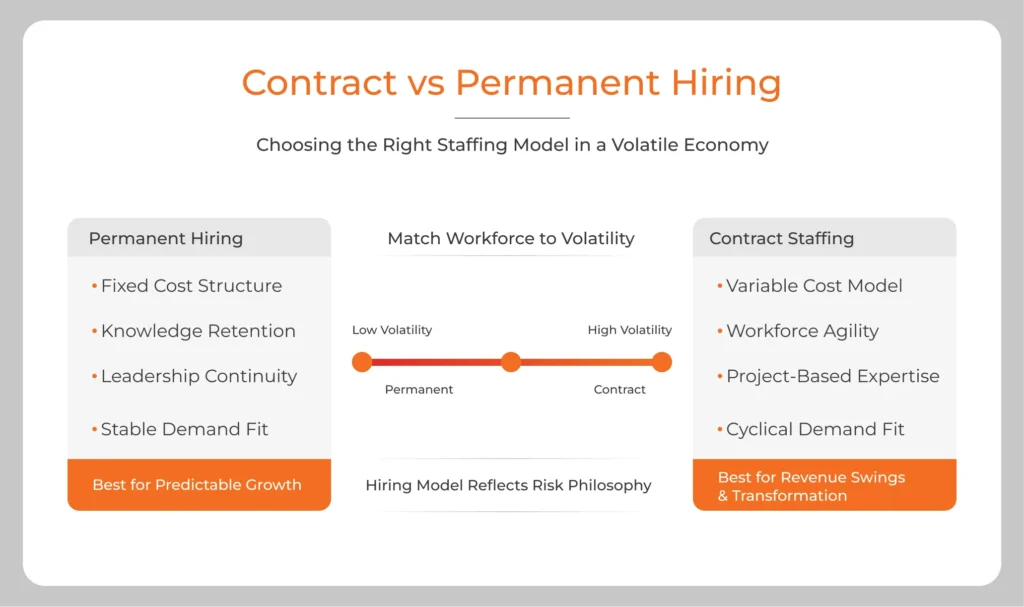
Hiring Models Reflect Risk Philosophy
Every workforce structure signals how a company manages uncertainty.
Permanent hiring assumes a certain predictability. It reflects confidence in sustained demand, stable revenue, and long-term capability building. Permanent staffing strengthens institutional memory and supports leadership pipelines. It anchors culture.
Contract staffing signals a different posture. It builds workforce agility, protects cost structures when demand is cyclical, and enables targeted expertise during transformation windows.
The mistake many organizations make is treating these as interchangeable tools. They are not. Each model changes how quickly you can respond to demand shifts, regulatory events, or investor pressure.
A flexible enterprise workforce strategy is ultimately a decision about how much volatility your operating model can absorb.
Role Criticality Should Drive the Decision
Most competitor content reduces this debate to cost-versus-flexibility tables. That framework is incomplete.
The real variable is role criticality.
There are roles that define intellectual capital. Think enterprise architects, compliance leads, platform owners, product strategists. These are foundational. Permanent hiring supports continuity in these areas because disruption here impacts enterprise value.
Then there are execution layers. Project-based technology builds, analytics sprints, market expansion pilots, and system integrations. These are ideal for contract staffing because the capability requirement is defined and time-bound.
When hiring models are mapped against business criticality rather than budget alone, workforce planning becomes far more precise.
This is where hiring strategy intersects with capital allocation. You are deciding which talent categories deserve long-term investment and which should scale dynamically.
Also read: Top 5 Benefits Of Hiring A Contract Worker
Economic Scenario Planning Matters More Than Cost
In a stable economy, permanent hiring can be cost-efficient over time. In a volatile economy, cost predictability becomes more valuable than cost minimization.
Consider a mid-market organization facing a 20 percent revenue swing across quarters. Permanent staffing locks fixed obligations into the system. Contract staffing adjusts with demand. The difference shows up in EBITDA volatility.
CFOs understand this instinctively. Less discussed is how hiring models influence forecasting accuracy. Workforce flexibility improves scenario modeling because labor costs can be stress-tested under multiple revenue outcomes.
A strong, flexible workforce approach gives finance leaders breathing room. It also gives HR leaders credibility in board conversations.
The conversation shifts from filling roles to shaping workforce architecture.
Culture and Cohesion Are Design Questions
A frequent concern in the contract vs permanent employment debate is culture dilution. The assumption is that contract hiring weakens team collaboration.
In reality, culture fragmentation occurs when integration governance is weak. Clear onboarding structures, aligned performance metrics, and transparent communication channels allow contract professionals to operate seamlessly alongside permanent employees.
Hybrid workforces are now common across enterprises. The decision on whether to combine models is now in the past. The question is whether leadership intentionally designs integration frameworks.
Organizations that treat contract professionals as transactional resources often see engagement gaps. Those who embed them into delivery structures see performance alignment.
So, workforce agility does not erode culture when governance supports it.
Managing Hiring Freezes and Budget Constraints
Economic tightening often leads to hiring freezes. Permanent hiring slows. Projects stall.
Contract staffing provides a controlled alternative. It allows progress on strategic initiatives without expanding fixed headcount. It also reduces the risk of overcorrection once markets stabilize.
For enterprise leaders, the flexibility to deploy specialized talent without long-term liability can preserve competitive momentum during downturns.
This is especially relevant in digital transformation, regulatory upgrades, and technology modernization programs where delays carry strategic cost.
Hiring models, therefore, become instruments of business continuity.
Can Both Models Work Together?
The most resilient organizations rarely choose one over the other. They design layered workforce ecosystems.
Permanent hiring anchors leadership, compliance, and core product ownership. Contract staffing supports transformation cycles, seasonal demand, and expansion initiatives.
What differentiates mature enterprises is clarity. They define which capabilities must remain in-house and which can flex with market dynamics. This clarity reduces reactionary hiring decisions and improves long-term workforce planning.
A flexible workforce strategy is most effective when it is proactive rather than reactive.
Also read: Global Workforce Compliance & Risk Management for Enterprise Hiring Programs
Workforce Planning and Forecasting Discipline
Workforce planning is often discussed as a forecasting exercise. In practice, it is a capital allocation exercise.
Permanent staffing increases the predictability of knowledge retention but reduces cost variability. Contract staffing increases cost variability but reduces structural exposure.
Organizations that align hiring models with demand volatility improve forecasting accuracy. They can model workforce costs more realistically across expansion and contraction cycles.
The question for leadership is simple. What volatility profile does the business carry, and how should the workforce mirror that profile?
This framing elevates hiring models from tactical decisions to strategic levers.
The Bottom Line
The debate between contract vs permanent hiring is often presented as a binary comparison. That framing oversimplifies a far more strategic question.
Workforce architecture must reflect business volatility, capital tolerance, and role criticality. When hiring models are chosen without scenario analysis, organizations inherit hidden risk. When chosen intentionally, they create resilience.
There is another layer leaders should consider. Talent markets themselves are volatile. Skill cycles are shortening. Technology expertise evolves quickly. In such environments, workforce flexibility becomes a competitive advantage, not just a cost control mechanism.
Enterprises that treat hiring models as components of a broader hiring strategy are better positioned to absorb economic shocks and capture growth windows. They move faster because their structure allows it.
The next phase of workforce maturity will belong to organizations that integrate contract staffing, permanent staffing, and nearshore or flexible teams into a unified governance framework.
At SPECTRAFORCE, we partner with HR Directors and CFOs to design workforce models aligned with business volatility and growth objectives. Whether you are evaluating contract staffing, strengthening permanent hiring pipelines, or building a flexible workforce strategy for 2026 and beyond, our experts help you plan with clarity and execute with precision.
Explore our staffing solutions today to design a hiring model that matches your risk profile and growth ambitions.
FAQs
Contract hiring can influence company culture, but the impact is determined far more by governance than by employment type. Organizations that treat contract professionals as integrated contributors, with clear onboarding, aligned KPIs, and defined reporting lines, typically maintain strong collaboration standards. Culture erosion usually stems from unclear ownership and fragmented communication structures rather than from the presence of contract talent itself.
Role suitability depends on criticality, continuity requirements, and business volatility. Positions tied to institutional knowledge, regulatory accountability, leadership succession, or long-term product ownership generally align with permanent hiring. In contrast, transformation initiatives, system migrations, analytics deployments, and other time-bound expertise requirements are often better served through contract staffing, where agility and specialized depth are priorities.
Each model reshapes cost predictability and risk exposure differently. Permanent hiring increases fixed cost obligations and strengthens knowledge retention, which can support long-term planning in stable revenue environments. Contract staffing introduces variable cost structures that improve responsiveness under fluctuating demand. When aligned with business volatility, both models can enhance forecasting accuracy and scenario planning discipline.
Yes. Contract staffing enables organizations to continue critical initiatives without expanding long-term headcount commitments. It provides access to specialized skills during constrained budget cycles while preserving financial flexibility. For many mid-market and enterprise organizations, this approach protects strategic momentum during periods of economic tightening.
Absolutely. Many high-performing organizations operate layered workforce models in which permanent employees anchor leadership, compliance, and core operations, while contract professionals support project execution and demand variability. The effectiveness of this approach depends on clearly defined role boundaries, consistent performance standards, and integrated workforce governance.