
Revenue in professional services is governed by timing and capability alignment. Deals are won on promise. Delivery is judged on speed and precision.
A consulting firm secures a transformation engagement. Mobilization is expected within four weeks. The proposal outlines the roles of cloud architects, change specialists, and data engineers. Inside the organization, capacity is thin. A few generalists are available. A delivery manager is already split across accounts.
The gap is operational, and it’s expensive.
This is where professional services staffing moves into strategic territory. Workforce design directly influences how quickly revenue converts from pipeline to billable delivery.
For mid-market and enterprise firms, staffing decisions shape margin stability, client retention, and growth velocity. Every deployment delay carries financial consequences. Every idle specialist impacts profitability.
The Utilization Equation Is Ruthless
Every delivery head understands the tension between billable utilization and bench capacity. A healthy bench provides resilience. An oversized bench erodes EBITDA.
The math is straightforward.
If utilization drops by even 5 percent across a 500-person consulting workforce, the impact compounds quickly. Salaries continue. Revenue does not. Forecast confidence declines. Pricing pressure intensifies.
This is why an agile workforce strategy is operational hygiene.
Experienced HR leaders already track:
- Billable utilization rates
- Forecasted pipeline vs confirmed revenue
- Skill concentration risk
- Time-to-deploy for niche roles
Why Traditional Hiring Models Strain Consulting Firms
Many firms still operate with fixed hiring cycles and reactive professional services recruitment. Hiring accelerates when the pipeline strengthens. It slows when demand becomes uncertain.
Over time, this approach can create pressure.
During growth phases, internal talent acquisition teams may struggle to mobilize quickly enough. During slower cycles, unused capacity can sit on the bench longer than planned, gradually affecting margins.
Project-based environments run on deal velocity and client timelines. Staffing for consulting firms, therefore, needs to align with contract wins, mobilization windows, and the skill intensity required at different engagement stages.
Revenue often fluctuates with client demand cycles, while payroll commitments tend to remain stable. As that spread widens, operating performance reflects the pressure.
Without deliberate workforce design, that imbalance can persist longer than leadership expects.
Also read: When Should Companies Opt for Project-Based Staffing Services
Redefining Professional Services Staffing
Professional services staffing means designing a workforce model that mirrors client volatility.
It combines:
- Core full-time delivery capacity
- Structured contingent workforce layers
- Offshore leverage for skill density
- Pre-qualified specialist pools
In practice, staffing for professional services involves forward-looking skill mapping. Firms analyze deal patterns, industry exposure, and transformation trends. They identify repeat capability clusters, such as SAP migrations, cybersecurity advisory services, AI integration, and regulatory modernization.
Instead of building a bench around individuals, they build a capacity model around skill blocks.
This is where consulting staffing solutions mature from transactional hiring into workforce architecture.
Managing Bench vs Billable Pressure
Bench management is rarely discussed openly. Yet it determines margin health.
The objective is not a zero bench, but an intelligent bench.
An optimized bench supports:
- Quick replacement for attrition
- Short onboarding cycles for new wins
- Internal mobility across accounts
Excessive idle capacity, however, signals poor forecasting or slow redeployment.
Flexible staffing for consulting firms allows leadership to protect utilization without compromising readiness. A blended model reduces long-term fixed exposure while preserving client responsiveness.
This is particularly relevant in multi-country engagements where skill scarcity differs by geography. Offshore and nearshore capacity can absorb volatility more efficiently than fully domestic teams.
Scaling for New Client Wins Without Panic Hiring
Winning large transformation deals often exposes workforce gaps.
Delivery leaders scramble. Recruitment pipelines stretch. Onboarding accelerates under pressure.
The risk is quality dilution.
With scalable staffing solutions, firms maintain curated talent networks aligned to core service lines. When a new engagement requires niche expertise, activation is immediate rather than speculative.
This approach also supports project-based staffing where talent demand peaks during design and implementation phases, then tapers during stabilization.
Instead of hiring permanently for temporary spikes, firms deploy structured contingent layers.
That decision alone can preserve a significant operating margin.
Rapid Deployment of Niche Skill Sets
Certain capabilities command premium billing rates. Cyber risk architects. Cloud-native engineers. Industry-specific regulatory consultants.
These professionals are scarce. Internal pipelines alone rarely sustain them.
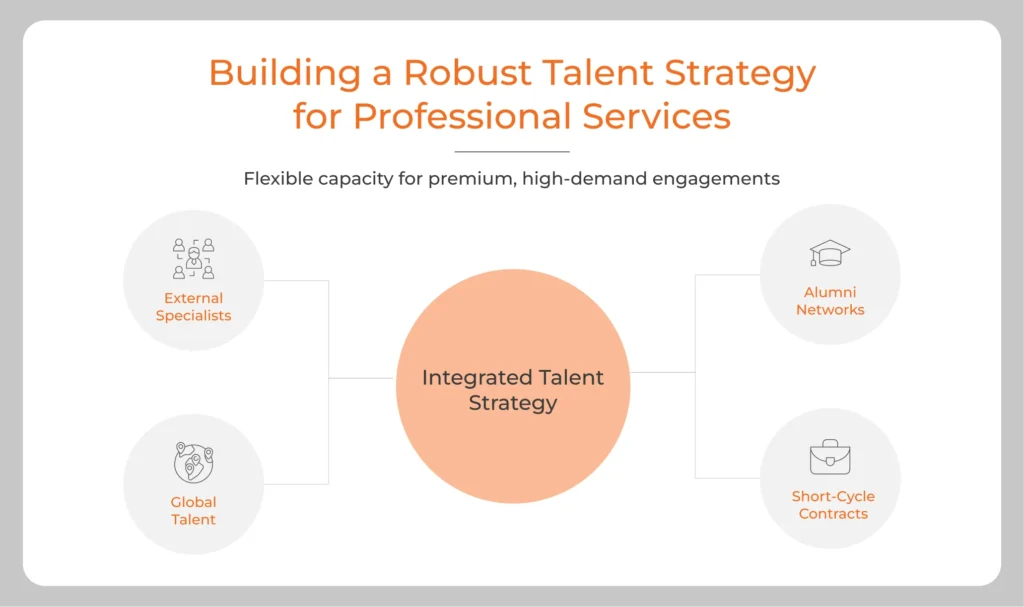
A mature talent strategy for professional services integrates:
- External specialist ecosystems
- Alumni networks
- Geographic arbitrage
- Short-cycle contractual deployment
When combined with rigorous onboarding frameworks, deployment speed improves without sacrificing governance.
The advantage compounds across engagements. Faster mobilization increases client confidence. Confidence improves renewal probability. Renewal improves revenue predictability.
Global Delivery and Offshore Leverage
Global delivery has moved beyond being about cost arbitrage alone. Resilience and scalability are important aspects now.
Firms leveraging offshore centers effectively can:
- Maintain higher utilization stability
- Balance skill shortages across regions
- Extend delivery windows without burnout
A structured contingent workforce integrated with offshore capacity creates layered elasticity.
This layered approach reduces exposure to sudden demand shifts while protecting client SLAs.
The Bottom Line
Workforce design now sits at the center of commercial strategy. Capacity decisions influence utilization, pricing confidence, and revenue timing. When staffing is aligned with forecasting and pipeline visibility, firms gain deployment speed and margin stability.
Consulting organizations that treat workforce planning as an operating discipline measure skill demand against growth projections, quantify the cost of delayed deployment, and maintain elastic capacity across regions. That discipline strengthens client trust and protects profitability.
SPECTRAFORCE partners with professional services firms at this strategic level. Through workforce modeling, utilization analytics, and scalable staffing solutions, SPECTRAFORCE enables agile teams that are ready when revenue converts.
Explore our staffing solutions today to build a staffing model that supports stronger utilization, controlled bench exposure, and predictable growth.
FAQs
Professional services staffing is a workforce strategy designed specifically for consulting, advisory, IT services, and engineering firms where revenue depends on billable project work. It focuses on aligning talent capacity with client demand cycles, ensuring teams can be deployed quickly without inflating fixed payroll costs.
Consulting firms manage fluctuating talent demand by building layered workforce models that combine full-time core teams with contingent specialists and offshore delivery capacity. This approach creates elasticity, allowing firms to scale up for new wins and scale down after project completion without destabilizing margins.
The best staffing model for project-based work is a blended structure that integrates permanent delivery leadership with flexible specialist deployment. This model ensures continuity in client relationships while allowing capacity to expand or contract based on project phase and skill intensity.
Professional services firms reduce bench costs by improving pipeline forecasting, accelerating cross-project redeployment, and using flexible staffing for consulting firms to avoid long-term fixed hiring for short-term demand spikes. Intelligent bench planning protects readiness without eroding profitability.
Staffing improves billable utilization rates by reducing time-to-deploy, aligning skill supply with confirmed revenue pipelines, and maintaining scalable staffing solutions that prevent idle capacity. When workforce planning is embedded into delivery forecasting, utilization becomes predictable rather than reactive.