
Growth in a mid-market company rarely gives advance notice. One quarter feels stable, even predictable. The next brings a new client win, a product expansion, or entry into a new geography, and suddenly, hiring demand doubles. What looked like a manageable headcount plan now feels outdated within weeks.
Most mid-market HR teams are intentionally lean. They are built to run efficiently, not expansively. The same recruiters manage sourcing, stakeholder alignment, employer branding, compliance, and candidate experience. When hiring volumes spike, there is no spare layer to absorb the pressure. Hiring managers step in to help screen profiles. Interview panels grow longer in an attempt to avoid mistakes. Decisions take more time because the stakes feel higher. Ironically, urgency slows everything down.
The business impact is subtle at first. A role remains open a little longer. A product release is shifted by a few weeks. A regional expansion pauses until leadership talent is secured. Then, cost pressure begins to show up. Overtime increases, agency spending becomes reactive. Internal teams stretch beyond capacity.
At that point, the conversation changes and becomes about whether the hiring system itself can scale without permanently increasing overhead. Can recruitment capacity expand during growth cycles and contract when demand stabilizes? Can speed improve without compromising hiring quality or financial discipline?
This is the space where mid-market staffing solutions enter the discussion. The objective is to introduce elasticity into hiring, protect business momentum, maintain cost visibility, and do so without building enterprise-level infrastructure that mid-market companies neither need nor want.
Designing that kind of hiring model requires rethinking how workforce capacity is structured in the first place.
The Structural Hiring Challenges Mid-Market Companies Face
In many mid-market companies, hiring friction builds inside the process itself. Bandwidth constraints, approval layers, and inconsistent demand patterns create pressure long before candidate supply becomes the issue.
Most mid-market companies operate with:
- Lean HR teams handling both transactional and strategic work
- Limited employer brand visibility compared to larger firms
- Aggressive growth targets tied to investor timelines
- Budget ceilings that demand cost-effective staffing services
When hiring demand spikes, internal systems stretch thin, interview loops expand, offer approvals slow down, and hiring managers grow impatient.
The result is a cycle in which speed drops, quality becomes inconsistent, and the cost per hire rises.
Many HR leaders describe it as trying to scale an engine that was designed for a smaller vehicle.
The need, therefore, is more than recruitment support. It is scalable hiring solutions that expand capacity without permanently expanding payroll.
Also read: Hiring Challenges Are Costing You More Than You Think! Here’s How Staffing Agencies Fix That
Why In-House Hiring Alone Stops Working
In-house hiring offers control and cultural alignment. It works well at steady hiring volumes. The challenge begins when demand becomes uneven.
Consider a mid-market technology firm launching two new product lines in the same quarter. Engineering demand doubles. Six months later, it drops back to baseline. Building a permanent internal team for that surge creates excess cost once the spike subsides.
Here, staffing solutions for mid-sized companies become operational shock absorbers.
A staffing services partner introduces elasticity. You can scale up recruitment capacity when required. You can reduce exposure once hiring stabilizes. The fixed cost structure remains intact.
For mid-market companies, elasticity is financial discipline.
Key Staffing Models That Work Best for Mid-Market Companies
The effectiveness of mid-market hiring solutions depends on selecting the right model for the right business scenario. SPECTRAFORCE focuses on three core approaches that align with workforce scaling for mid-market companies.
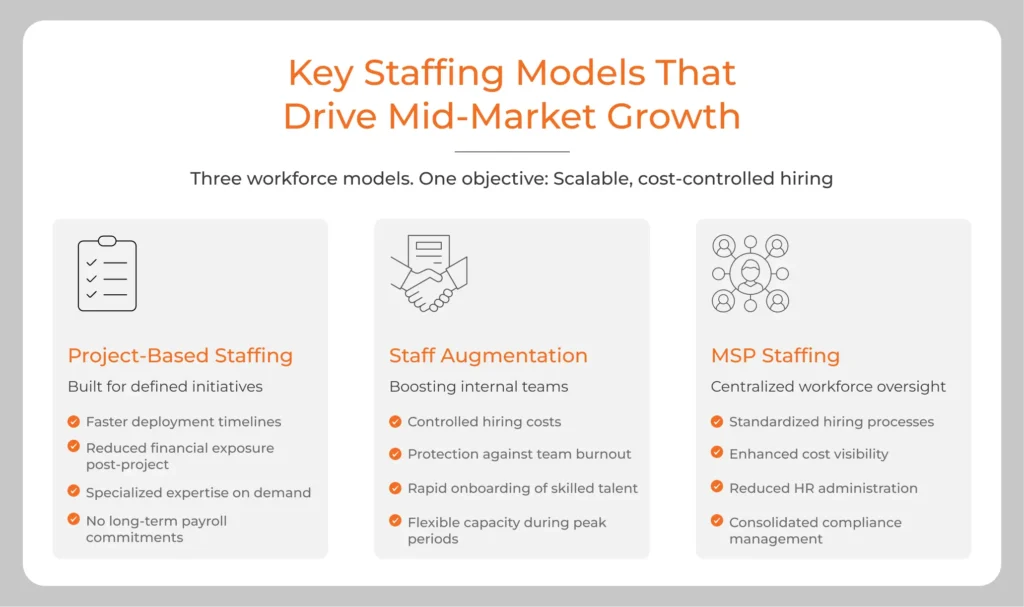
Project-Based Staffing
Project-based staffing is designed around defined deliverables and timelines.
Imagine a healthcare organization implementing a new digital patient portal. The rollout requires specialized IT talent for eight months. Once implementation stabilizes, demand drops.
Project-based staffing supports that lifecycle. It ensures the company can secure the necessary expertise without creating long-term payroll commitments.
Business outcome:
- Faster deployment timelines
- Reduced financial exposure post-project
- Access to specialized skill sets on demand
For growing companies managing digital transformation, this model preserves agility while maintaining delivery quality.
Also read: How Project-Based Hiring Drives Business Growth in 2026
Staff Augmentation
Staff augmentation strengthens existing teams without replacing them.
A mid-market financial services firm may have a strong internal compliance function but face seasonal spikes in regulatory reporting. Instead of overburdening core employees or delaying submissions, temporary specialists can be integrated seamlessly.
Business outcome:
- Controlled hiring costs
- Protection against burnout in lean HR teams
- Faster onboarding through pre-vetted talent
Staff augmentation supports flexible staffing solutions without altering core team structure.
MSP Staffing
Managed Service Provider staffing introduces centralized oversight across multiple roles or vendors.
As mid-market companies scale across geographies, fragmented vendor management often becomes inefficient. MSP staffing creates a structured layer that manages sourcing, compliance, and performance metrics under one governance model.
Business outcome:
- Standardized hiring processes
- Improved visibility into cost per hire
- Reduced administrative burden on internal HR
For organizations seeking strategic staffing aligned with long-term workforce strategy, MSP staffing enhances predictability.
Also read: Project Staffing vs. Managed Services: Which Delivers More Flexibility in Tech Hiring?
Speed Versus Precision in Mid-Market Hiring
Experienced talent leaders understand the tension between speed and perfection. In mid-market environments, extended hiring cycles often cost more than imperfect but capable hires.
The conversation shifts from finding the absolute best candidate to securing the right candidate within the right timeframe.
Staffing agencies for mid-market companies are structured to compress timelines. Pre-built talent pipelines reduce sourcing lag. Market intelligence informs compensation alignment early in the process.
When speed improves, downstream metrics follow. Product launches accelerate. Client onboarding remains uninterrupted. Revenue targets stay on track.
This is the operational value behind how mid-market companies hire faster.
Cost Control Without Compromising Quality
Budget pressure is constant in growth-stage firms. Yet aggressive cost-cutting in hiring often creates hidden expenses.
Poor hiring quality leads to:
- Higher attrition
- Rework
- Managerial distraction
Cost-effective staffing solutions balance financial discipline with quality control. Fee structures tied to defined deliverables provide transparency. Access to broader talent networks reduces advertising spend. Compliance management lowers legal risk.
For HR leaders measured on both hiring velocity and margin protection, this dual benefit matters.
Workforce Strategy in Growing Companies
Workforce strategy for mid-market companies requires foresight, scenario planning, and flexibility.
A staffing partnership allows HR leaders to forecast hiring demand based on product pipelines, market expansion, or regulatory changes. It introduces optionality into workforce planning.
Rather than reacting to hiring gaps, mid-market companies can proactively design their talent architecture.
This is where workforce solutions for mid-market businesses intersect with long-term business objectives.
Conclusion: Building Elastic Capacity as a Competitive Advantage
Mid-market staffing solutions often begin as tactical fixes. A difficult role. A tight deadline. A sudden expansion.
The real advantage appears when elasticity becomes embedded in workforce design.
Growing companies that outperform peers do one thing consistently. They treat hiring capacity as a scalable asset rather than a fixed function.
Elastic capacity allows them to pursue new revenue streams without fear of hiring bottlenecks. It enables experimentation, supports geographic expansion, and creates resilience during market volatility.
There is another, less discussed benefit. Data visibility improves. Staffing partnerships generate structured hiring metrics across time, roles, and regions. This institutional memory informs budgeting, compensation planning, and future talent investments.
In volatile markets, agility becomes a strategic differentiator. For mid-market companies, flexible staffing solutions create that agility without eroding fiscal control.
If your organization is preparing for accelerated hiring, entering a new market, or managing uneven demand cycles, this is the moment to reassess how capacity is structured.
SPECTRAFORCE works with mid-market companies to build that elasticity into hiring systems. Through project-based staffing, staff augmentation, and MSP staffing models, the focus remains on one outcome: expanding recruitment capacity in line with business demand while preserving financial discipline and governance clarity.
FAQs
The best staffing model for mid-market companies depends on hiring volatility and business objectives. Project-based staffing works well for defined timelines, staff augmentation supports temporary capacity gaps, and MSP staffing suits organizations requiring centralized vendor governance.
Mid-sized companies reduce hiring costs without slowing growth by leveraging cost-effective staffing services that introduce elasticity. By scaling recruitment capacity during demand spikes and reducing it afterward, companies protect margins while maintaining hiring speed.
A growing company should use a staffing partner rather than hiring in-house when demand fluctuates significantly or specialized skills are needed temporarily. A staffing services partner provides flexibility without expanding permanent payroll.
Whether staffing agencies are cost-effective for mid-market businesses depends on the lifecycle stage and hiring volume. In many growth scenarios, agencies reduce hidden costs linked to delayed hiring, compliance risks, and internal bandwidth constraints.
The speed at which staffing firms can fill roles for mid-market teams varies by industry and skill complexity. Established staffing models with active talent pipelines typically compress sourcing timelines significantly compared to purely in-house efforts.