
For a brief period, many enterprise leaders assumed that the shift to hybrid work would gradually reduce the relevance of embedded workforce models. Distributed teams were scaling. Remote tools were maturing. Oversight appeared increasingly digital.
That assumption is now being recalibrated.
As hybrid workforce structures stabilize, operational friction has not disappeared. In many regulated, high-volume environments, it has simply moved. What was once visible on the production floor is now fragmented across systems, vendors, and shifts. This is precisely why vendor on premise staffing is re-emerging as a serious strategic lever inside enterprise workforce strategy conversations.
This is a structural response to complexity.
Hybrid Has Stabilized, but Operational Complexity Has Not
Hybrid work has moved beyond being an experiment. Policies are clearer. Workforce segmentation is more deliberate. Corporate functions have settled into predictable rhythms.
Yet frontline and operational environments continue to face volatility.
Healthcare systems are balancing fluctuating patient loads. Manufacturing plants are navigating supply chain variability. Financial services firms are managing compliance oversight across distributed processing teams. Large enterprises operating in regulated markets are dealing with overtime spikes, attrition pockets, and uneven productivity visibility.
In these environments, digital dashboards alone are insufficient.
The need is for embedded accountability. That is where the vendor on premise staffing model is regaining traction.
Why On-Site Staffing Is Re-Entering Strategic Conversations
Experienced CHROs and Heads of TA understand that hybrid does not eliminate the requirement for physical workforce orchestration. It changes its shape.
An on-site presence today performs a different function than it did five years ago.
Modern on-site staffing within a vendor on premise structure enables:
- Real-time workforce analytics aligned with production demand
- Immediate escalation handling without layered approvals
- Continuous compliance monitoring in regulated environments
- Shift-level attrition analysis tied to retention interventions
- Overtime forecasting based on live workforce data
These are governance capabilities. They reduce friction at the operational edge.
In several large manufacturing networks, leaders found that hybrid corporate oversight improved strategic planning, yet frontline absenteeism trends were going unnoticed until metrics lagged. An embedded vendor team corrected this gap within one quarter by integrating workforce data streams and conducting live shift diagnostics.
That level of proximity changes outcomes.
Vendor On Premise Staffing in a Hybrid Workforce
There is a persistent misconception that vendor on premise services conflict with hybrid or flexible policies. In reality, they often strengthen them.
Hybrid workforce models separate strategic oversight from operational execution. Corporate functions may operate remotely, while site-level execution remains physical. Without an integrated coordination layer, misalignment grows.
A vendor on premise partnership staffing structure becomes that coordination layer.
It aligns:
- Enterprise workforce planning
- Site-level productivity targets
- Compliance documentation
- Contingent labor optimization
- Attrition mitigation strategies
In regulated industries, where audit trails matter as much as output, embedded vendor oversight ensures documentation accuracy and workforce governance continuity.
Hybrid requires orchestration. Vendor on premise staffing supplies it at the operational edge.
Which Enterprises Benefit Most Today
It is a myth that vendor on premise staffing is only useful for manufacturing and logistics. That is usually the case when organizations reduce it to volume management.
In practice, the vendor on premise model is increasingly relevant for:
- Healthcare systems managing clinical and non-clinical staffing volatility
- Financial institutions overseeing distributed processing centers
- Pharmaceutical production environments with strict regulatory exposure
- Large-scale shared services hubs
- Technology infrastructure sites with critical uptime mandates
These environments have three key characteristics: they are high-volume, compliance-sensitive, and unable to tolerate extended workforce disruptions.
Within such ecosystems, vendor on premise recruiting services provide continuity that remote-only models struggle to deliver.
From Recruiting Vendor to On-Premise Project Management Vendor
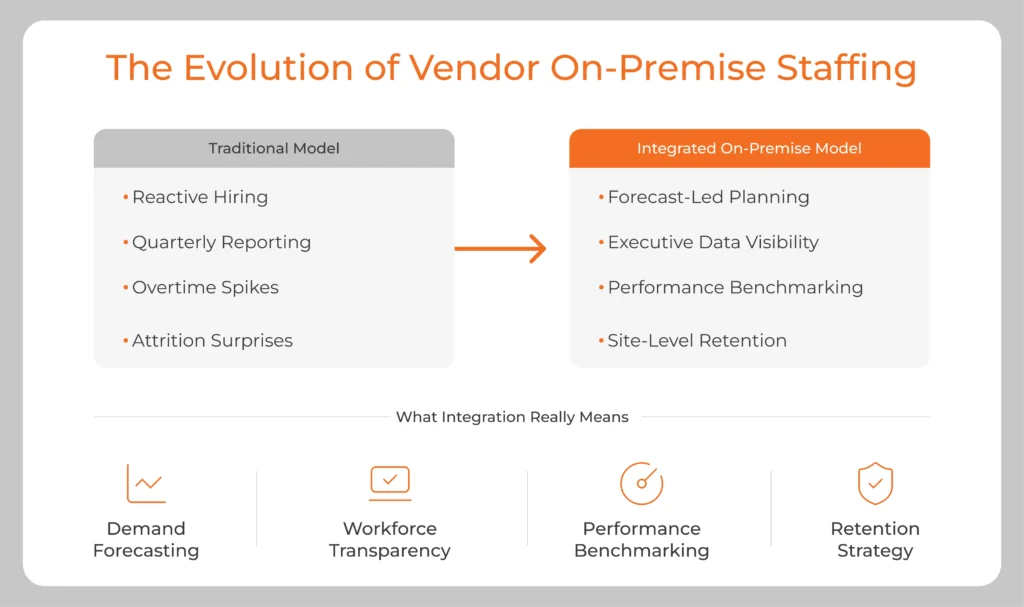
The evolution is subtle but important.
Enterprises are evaluating an on-premise project management vendor that integrates staffing with workforce governance.
That integration includes:
- Demand forecasting aligned with business cycles
- Workforce data transparency shared with executive stakeholders
- Continuous performance benchmarking
- Retention strategy deployment at the site level
In complex enterprises, staffing inefficiencies often surface in overtime cost curves, time-to-fill variances, and attrition clusters. A well-structured vendor on premise staffing approach addresses these at the source rather than after quarterly reporting.
It moves the conversation from requisitions to operational resilience.
Strategic Implications for Enterprise Workforce Strategy
Vendor on premise staffing is reappearing as a structural control mechanism.
Enterprise workforce strategy now requires three layers:
- Distributed strategic oversight
- Digital workforce intelligence
- Embedded operational coordination
The third layer has often been underestimated during rapid hybrid expansion.
When overtime escalates unpredictably or attrition spikes in specific shifts, digital reporting surfaces the symptom. Embedded vendor teams diagnose the cause in real time.
That distinction matters.
For large enterprises operating in regulated, operationally complex environments, this embedded layer can stabilize productivity curves and protect compliance exposure simultaneously.
Conclusion: Recalibration Signals Maturity
The resurgence of vendor on premise staffing reflects a more mature understanding of hybrid enterprise design.
Early hybrid adoption prioritized flexibility and technology enablement. The next phase is about structural resilience. Organizations are recognizing that distributed leadership requires anchored execution.
There is a deeper strategic benefit emerging.
Enterprises that integrate vendor on premise staffing into their enterprise workforce strategy gain longitudinal workforce intelligence. Embedded vendors accumulate site-specific performance data over time. Patterns become visible. Attrition drivers are identified earlier. Overtime anomalies are anticipated rather than reacted to.
This institutional memory compounds.
Over multiple fiscal cycles, enterprises can model workforce elasticity with greater precision. They can align the contingent labor mix with demand variability while tightening cost controls. They can design retention interventions tailored to specific site conditions.
Vendor on premise staffing, when structured as a governance partnership rather than a placement service, becomes an instrument of that orchestration.
Connect with SPECTRAFORCE to explore how a vendor on premise staffing partnership can strengthen operational governance, improve workforce visibility, and build long-term resilience into your enterprise talent model.
FAQs
Vendor-on-premise staffing is limited to manufacturing and logistics when organizations limit the scope to volume hiring. In practice, it is highly relevant for regulated, high-volume environments across healthcare, financial services, pharmaceuticals, and shared services operations.
On-site vendor staffing supports hybrid workforce models by acting as the operational coordination layer between remote strategic leadership and location-bound execution teams, ensuring compliance, productivity alignment, and workforce visibility.
The types of enterprises that benefit most from vendor-on-premise staffing today include large, regulated, operationally complex organizations in which workforce volatility directly impacts compliance, productivity, and cost structures.
Vendor-on-premise staffing conflicts with remote or flexible work policies only when workforce segmentation is poorly defined. In well-structured hybrid models, embedded vendor oversight strengthens accountability for location-bound roles.