
Large organizations rarely debate whether recruitment should be outsourced. The real concern is control.
They are thinking about brand integrity and the way every candidate interaction reinforces corporate reputation. Questions of data ownership and the security of information moving across interconnected systems sit close behind. Compliance has to stand firm across multiple jurisdictions at the same time, while financial leaders look for cost structures they can forecast with confidence. Above all, executives want assurance that if strategy shifts overnight, the hiring engine can realign just as quickly.
Because of this, discussions around enterprise RPO solutions are fundamentally different from conversations about filling vacancies.
At the Fortune 500 scale, talent acquisition functions as infrastructure. Small fractures widen quickly. Minor inefficiencies evolve into enterprise exposure.
So when leaders evaluate a partner, speed is not the primary question. The real test is whether an external provider can enter a highly complex operating environment, strengthen it, and still preserve stability.
That distinction changes everything.
What follows is a closer look at what truly defines success in enterprise settings, how operating models mature, and why governance frequently determines outcomes more decisively than sourcing capability.
Why Enterprise Complexity Changes the RPO Equation
A global manufacturer operating across 40 countries never hires to a single rhythm. Demand may surge in one geography while another enters a freeze. Regulations evolve, works councils assert influence, or a merger introduces systems that do not speak to each other. Meanwhile, a new product strategy can suddenly require capabilities that were not even on the workforce roadmap six months earlier.
In environments like this, conventional recruitment outsourcing logic starts to break down.
The problem is rarely volume, but variability.
When executives explore RPO for large companies, the underlying question is far more sophisticated than it first appears. They are trying to determine whether a partner can absorb volatility without compromising quality, weakening compliance, or unsettling stakeholder confidence.
This is why experienced buyers listen differently during evaluations. Providers often describe recruiter capability. Enterprises are assessing operating architecture.
They want clarity on how decisions are made and where authority resides. They want to see how information travels across systems and leadership layers. Accountability for risk must be explicit, especially when activities span multiple regulatory regimes. Performance measurement needs to remain comparable across borders and business units. And just as important, leaders expect a credible plan for both extremes of the demand curve, the moment hiring accelerates sharply and the moment it retracts.
If these foundations are unclear, strain will surface quickly. Early sourcing wins may create optimism, but without structural alignment the relationship becomes fragile long before the contract matures.
The Structural DNA of Enterprise RPO Solutions
The best global programs resemble federated systems. Central standards coexist with regional flexibility. Governance protects consistency while delivery adapts to local reality.
This balance is where many initiatives succeed or fail.
Global design with local intelligence
Headquarters typically requires unified reporting, common technology, and financial transparency. Regional leaders require autonomy to navigate labor markets, culture, and regulation.
Strong global RPO models recognize this tension instead of pretending it can be eliminated.
In many enterprise environments, leadership establishes a central governance body that brings together HR, procurement, and legal to safeguard standards across the organization. Regional teams retain flexibility to adapt sourcing strategies and employer branding to local market realities, yet core process controls and compliance requirements remain mandatory.
When structured this way, the organization gains agility without surrendering oversight.
Integration into enterprise rhythms
Recruitment does not operate in isolation. It is tied to workforce planning, finance approvals, internal mobility, and onboarding capacity.
Effective enterprise recruitment outsourcing integrates into these rhythms rather than sitting adjacent to them.
When a technology company shifted investment toward cybersecurity, the RPO provider embedded analysts into quarterly planning reviews. Hiring demand became predictable earlier. Bottlenecks reduced before they materialized.
This is operational maturity. It rarely appears in marketing decks, yet it determines whether transformation sustains.
Governance Is the Differentiator
Ask experienced CHROs why RPO initiatives fail and governance surfaces quickly.
The primary reason is that oversight among leaders is unclear.
Ownership architecture
In large programs, ambiguity around decision rights produces friction. Who approves process changes? Who signs off on workforce mix adjustments? Who escalates compliance risks?
High performing programs establish multi tier governance with defined authority at each level. Executive steering for strategy. Operational councils for delivery. Functional forums for continuous improvement.
When this is missing, providers improvise, enterprises react, and trust erodes.
Transparency that enables intervention
Reporting in global RPO governance is all about foresight.
Leaders need early signals like talent scarcity emerging in a niche market, agency dependency creeping upward, or offer acceptance declining for a specific demographic.
Good governance surfaces issues when they are still manageable.
Procurement as strategic partner
In Fortune 500 environments, procurement is deeply involved. Commercial structures must flex with hiring volatility and rate cards alone cannot capture value.
Some organizations introduce outcome based pricing tied to productivity or diversity impact. Others create gainshare mechanisms for technology adoption.
These structures require sophisticated collaboration. They are impossible without governance discipline.
What Mature Enterprises Expect From RPO Partnerships
Enterprise buyers repeatability instead of heroics. A strong RPO partnerships framework typically delivers three assurances including predictability of service quality across geographies, defensibility under audit, and measurable business impact.
In highly regulated environments, the ability to document each stage of the hiring lifecycle often proves more valuable than incremental improvements in speed. When audit readiness is built into daily operations, leaders gain confidence that growth will not introduce unseen exposure.
In other situations, organizations focus on strengthening employer brand coherence across geographies. Standardized communication frameworks can sit alongside room for local cultural nuance, allowing the enterprise to elevate candidate engagement while still protecting identity.
Together, these scenarios point to a consistent lesson. At scale, disciplined refinement tends to outperform dramatic disruption.
Choosing the Right RPO Model for a Global Enterprise
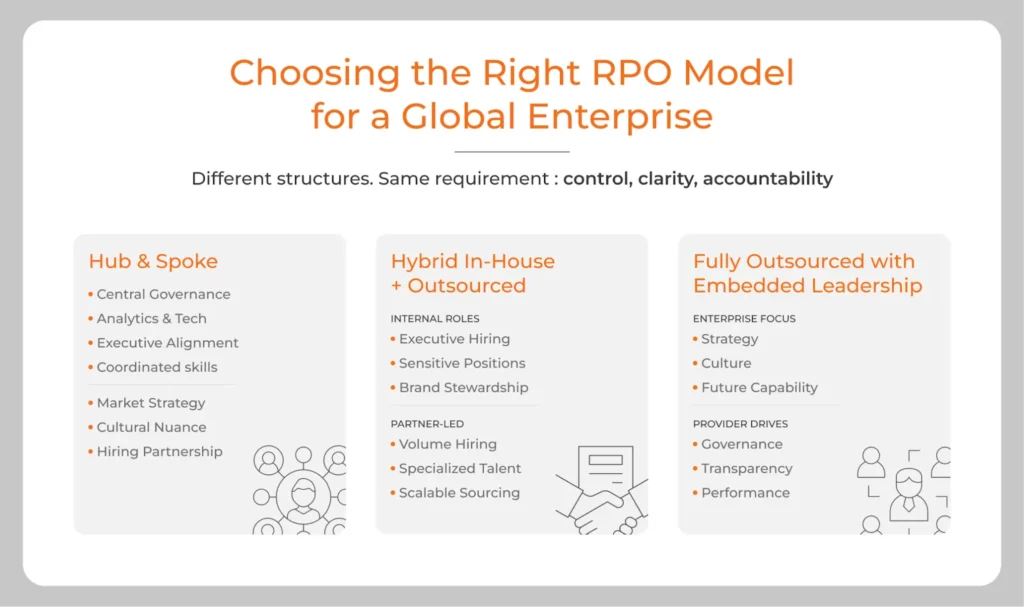
There is no universal blueprint for enterprise implementation. Organizations differ in geography, risk appetite, legacy infrastructure, and leadership philosophy. Yet when you examine RPO models that endure, several structural patterns appear repeatedly.
Hub and spoke
In this structure, a central function anchors governance and enterprise alignment, while regional or business teams execute with local expertise.
Typically, the central hub takes responsibility for:
- governance frameworks
- analytics and reporting standards
- technology ownership
- senior stakeholder engagement
Regional teams focus on navigating labor market realities, cultural nuance, and hiring manager relationships.
The result is global comparability without sacrificing local competitiveness. For diversified multinationals, this balance often proves both practical and resilient.
Hybrid in house and outsourced
Many enterprises prefer to retain direct ownership of sensitive or leadership hiring while leveraging external scale for volume or niche capability areas.
In these environments:
- executive or critical roles remain internal
- high volume segments move to the provider
- specialized talent pools may sit with whichever side has stronger expertise
The success factor here is the interface. When decision rights and workflows are crisp, the model accelerates delivery. When they are not, duplication appears quickly and accountability blurs.
Fully outsourced with embedded leadership
Some organizations choose deeper delegation. The provider assumes responsibility across the lifecycle and often contributes advisory insight into planning and market dynamics. Internal teams redirect energy toward culture, long term capability, and enterprise strategy.
This design can unlock significant leverage, but it depends on:
- mature governance
- radical transparency
- executive trust
- disciplined performance management.
Any of these structures can operate as true end-to-end RPO solutions. What ultimately determines success is explicit accountability, well defined authority, and integration into the existing machinery of the enterprise.
Also Read: RPO for Healthcare: Solving Compliance and Talent Shortages Together
Metrics That Matter at Enterprise Scale
Executives evaluating RPO performance metrics rarely stay focused on transactional indicators for long.
Time to fill remains important. Yet in isolation, it offers an incomplete picture of value.
Mature programs extend measurement into the language the business already understands. They examine how hiring influences productivity ramp, revenue per employee, representation within leadership pipelines, and retention across critical skill segments. Recruitment performance becomes connected to operational and financial outcomes rather than existing as a standalone activity.
As integration deepens, talent acquisition shifts from reactive service delivery to forward-looking insight. Patterns emerge earlier. Tradeoffs become clearer. Leaders gain the ability to intervene before constraints begin to slow growth.
In some enterprises, aligning hiring velocity with delivery commitments has reshaped investment logic. When workforce readiness becomes visible alongside commercial timelines, recruitment moves from a support function to a strategic lever.
Also read: RPO Cost vs. Value: Is It a Smart Investment for Your Hiring Strategy?
Implementation Reality Across Fortune 500 Environments
Energy is typically high when a program launches. Expectations are clear, sponsorship is visible, and momentum feels strong. Then the operating complexity of the enterprise begins to surface.
Global scale introduces interdependencies that no blueprint can fully anticipate. The difference between programs that stabilize and those that stall often lies in how quickly both parties adapt once reality replaces design.
Change management is operational, not ceremonial
Adoption cannot rely on announcements or training sessions alone. Hiring managers need confidence in new workflows because those workflows shape their ability to deliver business outcomes. Regional HR teams must know exactly where issues travel when something breaks. Technology behavior must be reinforced daily until it becomes habit.
When change management is treated as a communications exercise, friction accumulates quietly. Even well designed solutions can falter under the weight of inconsistent usage.
Technology harmonization takes patience
Enterprises carry history inside their systems. Local contracts, legacy integrations, and long standing process variations rarely yield to standardization overnight.
Programs that succeed acknowledge this from the start. They design phased pathways toward alignment, prioritizing interoperability and risk reduction before pursuing absolute uniformity. Progress becomes durable because it respects operational gravity.
Capability transfer must be structured
Transitions often expose how much knowledge sits informally within existing teams. If that expertise disappears too quickly, service continuity suffers and confidence erodes.
Effective implementations protect against this through deliberate overlap, rigorous documentation, and shared accountability during early stages of delivery. Stability is preserved while new capabilities take root.
Enterprises evaluating RPO for Fortune 500 environments understand these dynamics well. They expect partners to confront them openly, with practical plans rather than optimistic assumptions.
Risk, Compliance, and the Global Footprint
Large enterprises operate in an environment of constant visibility. Hiring decisions shape corporate reputation, regulatory standing, and the confidence employees place in leadership.
Within this context, a credible RPO service must show more than delivery capability. It needs demonstrable command of local labor frameworks, data protection obligations, and evolving diversity mandates. More importantly, it must anticipate regulatory movement rather than react to it.
The challenge intensifies when operations span borders. A vulnerability in one jurisdiction rarely remains contained. Issues travel through shared systems, public perception, and governance channels with surprising speed.
For this reason, experienced buyers often prioritize compliance maturity above sourcing ingenuity. Creativity has value, but stability protects the enterprise.
To Conclude
Most programs begin by stabilizing delivery. Processes align, service levels recover, and confidence returns. The real advantage appears after that.
Once foundations are secure, leaders can interrogate deeper questions around workforce mix, automation, and geographic strategy. Shared data begins to reveal patterns. Over time, the partnership develops memory, understanding where scarcity will emerge, which skills will command premiums, and how demand behaves under pressure.
This is where Flexible RPO Solutions prove their strategic importance. They evolve with the enterprise rather than forcing the enterprise to reset with every change.
Eventually, accumulated intelligence becomes the differentiator. Commercial terms can be matched. Experience built through years of operating together cannot.
For decision makers, selecting among Enterprise RPO providers is more about building a system that learns.
As boards, investors, and regulators demand greater transparency into workforce resilience, a mature Enterprise RPO Solutions framework enables leaders to respond with clarity and evidence.
Organizations that treat RPO as infrastructure will strengthen over time. Those that treat it as a utility will remain in perpetual transition.
The advantage will belong to enterprises whose talent systems remember.
Looking for an RPO partner built for enterprise complexity?
SPECTRAFORCE delivers global governance alignment, regulatory confidence, and workforce scalability across multi-country environments. Let’s explore how your hiring model can operate with greater control and visibility.
FAQs
The difference between enterprise RPO and traditional staffing is that enterprise RPO integrates governance, technology, compliance, and workforce strategy into a unified operating model, whereas staffing typically focuses on filling individual roles or providing contingent labor.
Governance works in large-scale RPO programs through structured decision frameworks that define executive oversight, operational accountability, risk management, and performance transparency across regions and stakeholders.
KPIs define success in enterprise RPO by linking recruitment outcomes to business impact, including productivity, quality of hire, workforce diversity, hiring manager satisfaction, and long term talent sustainability.
RPO is suitable for Fortune 500 organizations when the model supports global consistency, regulatory compliance, scalability, and integration with financial and workforce planning processes.
It takes to implement enterprise RPO several months to over a year depending on geographic footprint, technology landscape, change readiness, and the depth of process transformation required.