For most of modern business history, starting a new job meant stepping into a shared physical environment. Learning happened through proximity. New employees watched how decisions were made, how managers interacted, and how work actually flowed across teams. Expectations were conveyed through small, unspoken signals such as who spoke first in meetings, how quickly emails were answered, and which problems were treated as urgent.
That context disappears the moment work moves out of the office.
Today, many employees begin their roles without ever walking into a workplace. They log in from home, meet colleagues through screens, and rely on written guidance instead of informal observation. In this setting, the first weeks are no longer shaped by surroundings, but by systems, documentation, and deliberately created human touchpoints.
This shift changes the employee onboarding process at a structural level. It is no longer sustained by visibility and routine interaction, but depends on how well the organization designs the experience of entering the workplace. The quality of that design now determines whether a remote employee feels oriented or isolated, confident or uncertain, capable or disconnected.
This is why modern remote onboarding has moved beyond procedural orientation. It has become a strategic capability that directly influences performance, engagement, and long-term retention.
What Remote Onboarding Really Changes
Virtual onboarding is often described as a digital version of traditional onboarding. That framing is misleading.
Remote onboarding alters three fundamentals.
First, learning becomes asynchronous by default. Instead of learning through constant exposure, new hires are learning through artifacts such as recorded training, written processes, and scheduled interactions.
Second, culture becomes interpreted instead of experienced. Values are no longer observed in how leaders behave in shared spaces. They are inferred from how managers respond in Slack, how meetings are run, and how mistakes are handled when no one is physically present.
Third, early performance becomes more fragile. In a physical office, confusion is visible. In a remote work environment, confusion is silent unless intentionally surfaced.
Organizations that fail to account for these shifts tend to assume that remote onboarding is simply onboarding with video calls. In practice, it is closer to building a small operating system for every new hire.
Why the First 90 Days Carry More Weight in Distributed Teams
The first 90 days have always mattered. In distributed teams, they determine almost everything.
Early ambiguity compounds faster in remote settings. A new hire who misunderstands priorities in week two may spend weeks executing against the wrong mental model of the role. By the time misalignment becomes visible, momentum is already lost.
There is also a psychological dimension. A remote employee does not receive the ambient reassurance of belonging that physical offices provide. Silence can be interpreted as neglect, and delays can feel like disapproval. The emotional risk of disengagement is higher even when intentions are good.
Strong remote onboarding programs therefore treat the first 90 days as a staged integration process rather than a single event. The goal is not just task readiness but confidence, clarity, and social anchoring.
High-performing organizations structure this period around three outcomes.
- Understanding how the business actually works
- Knowing how success is evaluated
- Feeling safe enough to ask questions early
Without these, performance issues often appear months later and are mistakenly attributed to hiring quality rather than onboarding design.
Also read: 7 Effective Remote Team Engagement Practices for Today’s Evolving Workplace
Designing the Employee Onboarding Process for Remote Reality
An effective employee onboarding process for remote hires begins before the first login.
Preboarding matters more when no one is physically present to help troubleshoot. Equipment, credentials, and access must arrive fully functional. A broken first day creates doubt that is difficult to erase later.
Once formal onboarding begins, content sequencing becomes critical. Flooding a new hire with documents and tools creates cognitive overload. The learning curve should be shaped intentionally.
Experienced organizations divide early onboarding into progressive layers.
- Orientation to the business and its mission
- Role clarity and performance expectations
- Systems and workflows
- Social integration
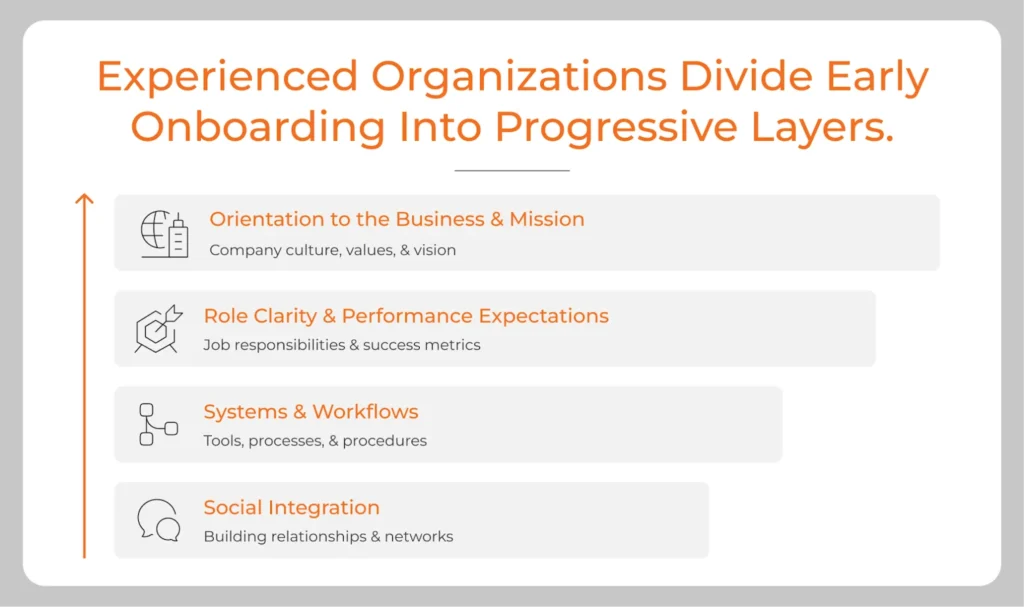
This sequence mirrors how people naturally build mental models. First, they need to understand where they are. Then what are they responsible for? Only after that does process detail become meaningful.
In a remote work environment, this progression must be visible and guided. A structured roadmap replaces informal observation.
Also read: 6 Ways To Positively Build Virtual Relationships With Your Team
Supporting New Hires Through Manager Behavior
Technology enables virtual onboarding. Managers make it work.
The most common failure point in remote onboarding is the lack of interpretive guidance. New hires often understand what to do but not how to judge whether they are doing it well.
Effective managers in distributed teams externalize expectations. They narrate decisions, explain tradeoffs, and clarify what good looks like before mistakes occur.
They also replace casual check-ins with intentional feedback loops. In an office, a raised eyebrow can signal misalignment. In remote work, feedback must be explicit and frequent.
The goal is not micromanagement, but structured presence with:
- Weekly one-on-ones focused on priorities rather than tasks
- Early review of first deliverables with context
- Clear articulation of how work connects to business outcomes
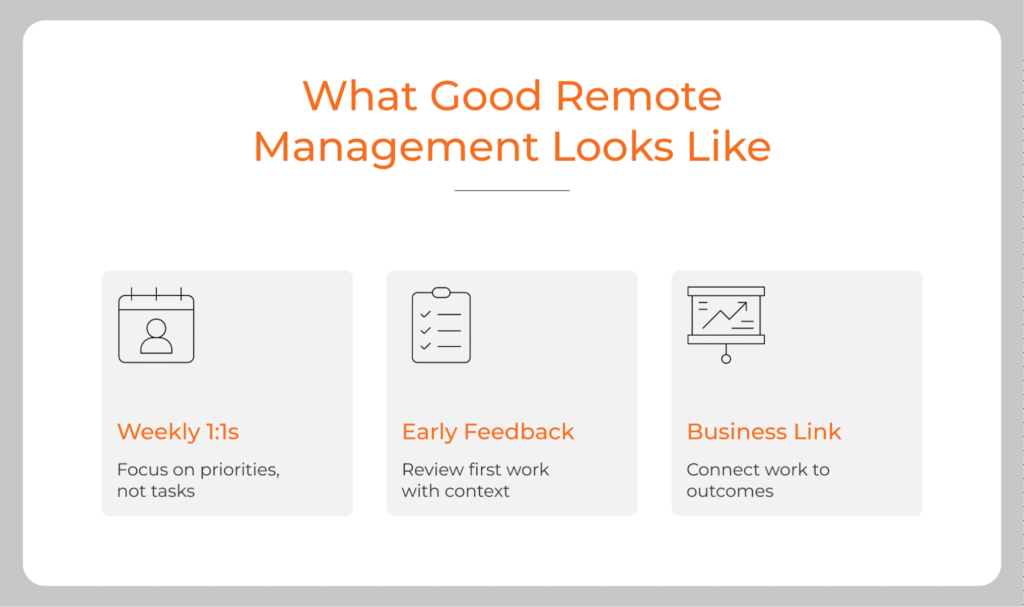
These behaviors shorten the time it takes for a remote employee to internalize standards and norms.
The Role of Tools in Modern Remote Onboarding
Tools shape organizational experience.
Learning management systems support knowledge transfer. Collaboration platforms enable social exposure. Workflow tools provide visibility into how work moves across teams.
What distinguishes modern remote onboarding from improvised setups is integration.
When systems are fragmented, new hires spend their first weeks navigating software rather than learning the business. When systems are connected, onboarding feels like a guided path rather than a maze.
Strong programs treat tools as narrative devices and show how work flows from request to outcome. They reveal dependencies and make invisible processes visible.
The most useful tools are those that reduce uncertainty. This includes dashboards that show progress, documentation that explains not only what to do but why it exists, and shared spaces that normalize questions.
Also read: The Future of Remote Work: How to Adapt with AI & Cybersecurity?
Retention Starts Earlier Than Most Organizations Realize
Employee retention is often framed around engagement programs and long-term career development. In distributed teams, however, the foundations of retention are laid much earlier, during remote onboarding itself.
Research from Gallup shows that organizations with strong onboarding processes improve new hire retention by 82% and productivity by over 70%.
New hires begin forming judgments almost immediately about whether the organization is well run, whether leaders are reachable, and whether success feels realistic in their role. Those early impressions shape commitment long before formal performance reviews ever come into play.
When remote onboarding is weak, initial friction tends to become internalized. Confusion is interpreted as dysfunction. Silence feels like indifference. Over time, small frustrations accumulate into a broader belief that the organization lacks structure or care. When onboarding is strong, the same early challenges are experienced differently. Obstacles feel temporary. Questions feel welcome. Progress feels possible.
This distinction matters because the cost of attrition is higher in distributed teams. According to research by the Society for Human Resource Management, the cost of losing an employee can range from 50% to 250% of their annual salary, depending on the role and level of specialization.
Replacements take longer to integrate, knowledge is harder to transfer, and trust within the team must be rebuilt almost from scratch. Retention, in this context, becomes less about surface-level incentives and more about early psychological safety. People are more likely to stay when they understand what success looks like and believe they have a fair chance of reaching it.
The Bottom Line
Organizations that do remote onboarding well treat it as an operating discipline. The experience is reviewed with the same seriousness as any core business process, focusing on where new hires lose confidence, misread expectations, or slow down. Those signals are used to refine onboarding based on real outcomes instead of theoretical process maps.
They also accept that onboarding cannot stay fixed. As roles evolve and teams spread across locations, what once worked through observation must now work through structure. Over time, onboarding begins to reflect how clearly an organization understands its own priorities and decision paths.
Remote onboarding has become a lasting test of how well intent is translated into systems. Strengthening it requires moving beyond checklists and asking harder questions. How quickly does a new hire understand how decisions are made? How early do they feel their work is seen and valued? How clearly can they picture a future inside the organization?
When those answers are visible early, integration accelerates naturally. Organizations thus build cultures that hold together across distance. Modern remote onboarding may be seen as recreating the office on screen, but it actually involves creating clarity where proximity once did the work.
Build a stronger remote onboarding strategy with SPECTRAFORCE.
Our staffing solutions help organizations design onboarding experiences that accelerate performance, strengthen retention, and scale across distributed teams. Talk to our experts about building an onboarding model that supports both your people and your business goals.
FAQs
Remote onboarding is the process of integrating a new hire into an organization when they begin work outside a physical office through structured digital systems, guided learning, and intentional manager interaction.
Employers can support employees who are starting a new job remotely by providing clear role expectations, structured learning paths, regular feedback, and visible social connections within distributed teams.
The first 90 days are critical for remote employee performance and engagement because early clarity, confidence, and belonging determine how quickly a new hire internalizes standards and sustains motivation.
Effective remote onboarding influences employee retention and long-term success by reducing early frustration, strengthening role understanding, and building trust in organizational systems.
Tools that support effective remote onboarding include learning management systems, collaboration platforms, workflow visibility tools, and centralized documentation that reduce uncertainty and guide performance.