
Every few years, a corner of the labor market stops following the rules that govern the rest of the market. In 2026, that corner is AI. While overall global hiring remains below pre-pandemic levels, AI-related job postings have surged considerably, making AI in hiring a category unlike anything else in today’s labor market.
The divergence is too sharp and too consistent to be cyclical. It is structural, and it makes AI in hiring the most consequential talent challenge most organizations are navigating right now.
The real challenge of AI in hiring runs deeper than most talent strategies admit. Companies are chasing the same narrow pool of people who can build, deploy, and govern AI at enterprise scale, and that pool isn’t growing fast enough. The organizations gaining ground are the ones that have fundamentally rethought how AI teams get structured, sourced, and scaled.
AI Skills in Demand: The Roles Companies Are Hiring for in 2026
The skills in demand for AI in hiring have moved well beyond the data scientist archetype that defined the previous decade. Here are the five roles driving the most hiring activity:
AI/ML Engineer
From building to training, and shipping models into production environments. This is the core role every AI-investing organization needs first, and the one with the sharpest supply constraint.
MLOps Engineer
This is someone who manages model performance and retraining at scale. As companies move from AI pilots to production systems, the operational layer around deployed models has become a hiring priority in its own right.
Forward-Deployed Engineer
Adapts AI systems to work within client-specific environments and operational constraints. A newer title is gaining serious traction, particularly among companies that sell AI-powered products and services.
AI Governance and Ethics Specialist
Regulatory pressure is making this one of the fastest-growing categories in enterprise AI hiring. The EU AI Act’s compliance obligations beginning in August 2026 are accelerating demand across regulated industries and organizations.
Data Annotator
Understated in executive conversations, but the fastest-growing role by volume. The labeled data pipelines that underpin model quality require this function at scale, and demand is formalizing rapidly.
Also Read: The Role of AI and Automation in Staffing Solutions
Why the AI Talent Shortage Is Getting Worse
Most organizations treat AI in hiring as a lag problem: demand is ahead of supply, but supply will eventually catch up. The data makes a different case.
The pipeline math does not work
Just 205 AI PhDs were awarded in the United States in 2022, and over half of all AI master’s and doctoral degrees earned in the US were earned by non-citizens, making the talent pipeline structurally dependent on immigration policy.
The academic side of this equation is further weakened by a finding from Stanford HAI’s 2024 AI Index: 70.7% of new AI PhDs went directly to industry rather than academia, up 5.3 percentage points in a single year. The people best positioned to train the next generation are increasingly choosing not to. Supply cannot self-correct at the pace at which demand is moving.
Skills are expiring faster than companies can build them
The skills in demand are shifting faster than most hiring pipelines are built to track.
There is also a secondary problem that gets less attention. AI is automating the entry-level work that traditionally builds senior talent over time. Fewer junior roles means fewer people developing into the specialists organizations will need in three to five years. The gap keeps widening from both ends.
AI Staffing Solutions: How Companies Are Scaling AI Teams
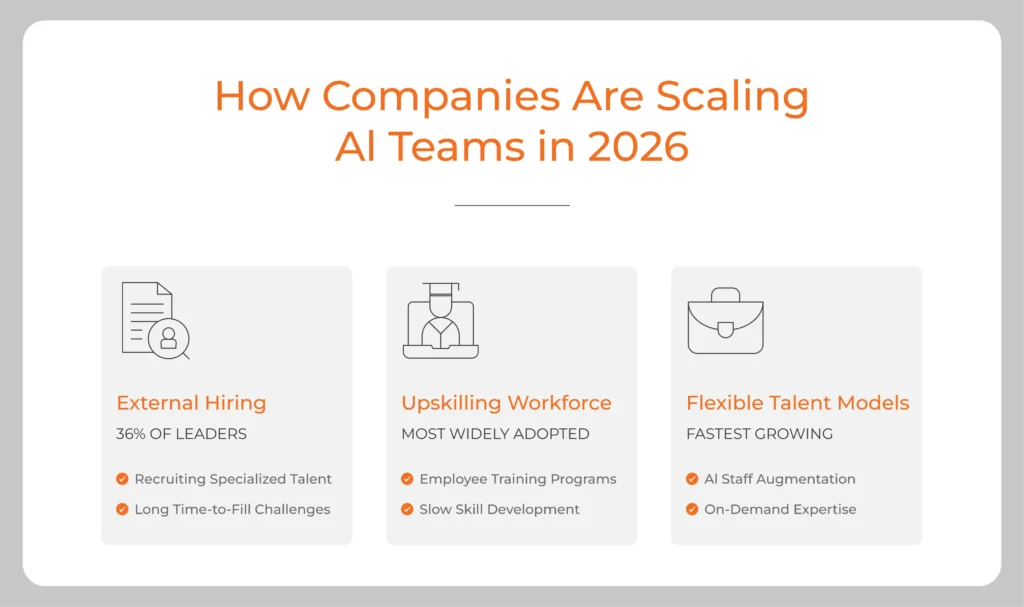
But organizations are not waiting for the gap to close. The ones making progress are combining three approaches to build AI teams in the meantime.
- Direct external hiring is where most organizations start. Enterprise leaders identify this as their primary AI staffing strategy. It works for core architectural roles but runs into consistent friction: thin candidate pipelines, extended time-to-fill, and retention risk.
- Upskilling the existing workforce is the most widely adopted approach. The problem is training programs take time most active AI roadmaps cannot accommodate.
- Flexible workforce models, including AI staff augmentation and project-based AI talent, are growing fastest. The reason is structural. AI development does not follow steady headcount cycles. It scales in phases tied to model development, production deployment, and governance implementation. Augmentation aligns with that pattern of work in a way that traditional full-time hiring does not.
Also Read: How AI Spending Is Shaping Tech Hiring Trends for 2026
How Leading Companies Are Designing AI Teams That Actually Deliver
The AI talent gap will not close through better sourcing alone. The companies making measurable progress are those that treat AI in hiring as a workforce architecture decision rather than a recruiting problem. They are mapping capability requirements to phases of their AI roadmap, identifying where permanent hires create long-term leverage, and using flexible AI staffing solutions to fill the gaps in between.
The right technology staffing services partner makes that shift repeatable and builds it into how the organization hires going forward.
SPECTRAFORCE provides technology staffing services to enterprise organizations building AI teams designed for both immediate delivery and long-term capability, from permanent technical hiring to scalable staff augmentation aligned with your roadmap. Book a 15-minute discovery call to start the conversation.
FAQs
AI roles most in demand in 2026 include AI/ML Engineers, MLOps Engineers, Forward-Deployed Engineers, AI Governance and Ethics Specialists, and Data Annotators. The focus has moved from general data science toward production and governance profiles, reflecting where most enterprise AI programs are today.
The global shortage of AI talent comes down to a structural mismatch that has been building for years. Academic programs produce generalists while industry demands specialists. The professionals best positioned to train the next generation are increasingly moving into private sector roles. And the skills required to work in AI today look meaningfully different from what was considered sufficient two years ago, making experience shelf life unusually short.
Skills companies look for when hiring AI engineers in 2026 center on production readiness. Hands-on experience with MLOps, retrieval-augmented generation, agentic frameworks, and tools like LangChain and PyTorch are baseline expectations. AI governance and compliance literacy are increasingly required in regulated industries.
AI staffing partners help companies scale AI teams faster because they maintain active relationships with specialized talent that most internal teams cannot access on their own. Engagements are structured around specific program phases, which keeps delivery moving without the overhead of permanent hiring.
Companies should use AI staff augmentation when they need specialized capability for a defined phase of work such as model deployment, MLOps pipeline development, or governance implementation. These are project-bound needs where permanent headcount creates more overhead than value.