
Technology leaders across Canada are running into the same wall. The budget is approved, the roadmap is set, but the hiring process stalls everything before the team can move. Specialized roles stay open long enough to delay entire project timelines, and the pressure to deliver does not pause while the search continues.
Canadian companies are leaning on every channel available, and the gap keeps widening. CTC estimates that Canada falls short by more than 3,000 AI specialists every year. That figure does not account for the broader pressure building across cloud and cybersecurity sectors.
That shortage has pushed many organisations toward contract tech hiring models and specialised IT staffing partners in Canada, turning what was once a contingency option into a frontline workforce strategy.
For companies navigating digital transformation under hiring pressure, the model offers speed and specialization that traditional hiring cycles struggle to match.
The Roles Canadian Companies Are Filling Through Contracts
The shift toward IT contract staffing is most pronounced where the talent shortage is most severe and where project timelines cannot afford a four-to-six-month permanent hiring cycle. These are the roles seeing the highest contract demand right now:
- AI engineers: As Canadian companies move from AI pilots to enterprise deployment, the demand for professionals who can own end-to-end machine learning systems at scale has outpaced what most internal teams can build. Global competition for this talent makes permanent acquisition a slow and often unsuccessful path.
- DevOps engineers: Companies accelerating cloud migration or modernizing delivery pipelines need DevOps expertise for the length of a transformation initiative, not indefinitely. Contract engagements match that reality.
- Cloud architects: Senior-level multi-cloud experience across AWS, Azure, and Google Cloud is in sustained demand as enterprises move off legacy infrastructure. Working with contract IT staffing providers in Canada gives organisations access to specialised talent without long-term headcount commitments.
- Cybersecurity professionals: Qualified candidates field multiple competing offers, and compensation expectations consistently outpace most hiring budgets. IT staffing Canada specialists provide organizations with a realistic path to coverage while a longer-term permanent strategy takes shape.
Also Read: The Role of AI and Automation in Staffing Solutions
Why Contract Staffing Works in 2026
When a permanent role stays open for three months, the real cost shows up across delayed project timelines, stretched teams, and lost momentum. Contract staffing services for tech teams address exactly that, enabling companies to hire IT contractors in Canada at a pace permanent hiring cycles rarely match.
Organizations that need to hire IT contractors Canada-wide for cloud, AI, or cybersecurity programs can significantly reduce time-to-fill by working with a specialist staffing partner.
Beyond speed, IT contract staffing offers a structural fit for how technology work is actually organized. Many digital transformation initiatives have a defined scope, a clear delivery phase, and a natural endpoint. Hiring a permanent employee for that window creates a mismatch between workforce cost and actual business need. When the project closes, IT staffing Canada specialists can be transitioned out cleanly, keeping headcount aligned with where the work actually stands.
Skill currency is another reason IT contract staffing has become a deliberate part of how technology teams in Canada are structured. Contractors who specialize in cloud-native architecture or generative AI frameworks often carry more current, hands-on experience than permanent employees embedded in a single organization for years.
When a complex deployment requires someone contributing from day one, that currency makes a measurable difference. It is one of the core reasons temporary IT staffing has moved from a contingency measure to a frontline capability strategy.
Contract Staffing vs. Permanent Hiring: How to Know Which One Your Team Needs
Both models serve a purpose, and the organizations getting the most out of their talent strategy are the ones that know which one fits the moment. IT contract staffing and permanent hiring solve different problems. Understanding which applies to your situation is where every IT staffing Canada conversation should start.
Use contract staffing when:
- The need is tied to a specific project or initiative with a defined end
- Speed to placement is critical, and the role cannot stay open through a lengthy search process
- The required skill is highly specialized and not needed permanently
- You are not yet certain what internal capability you want to build long-term
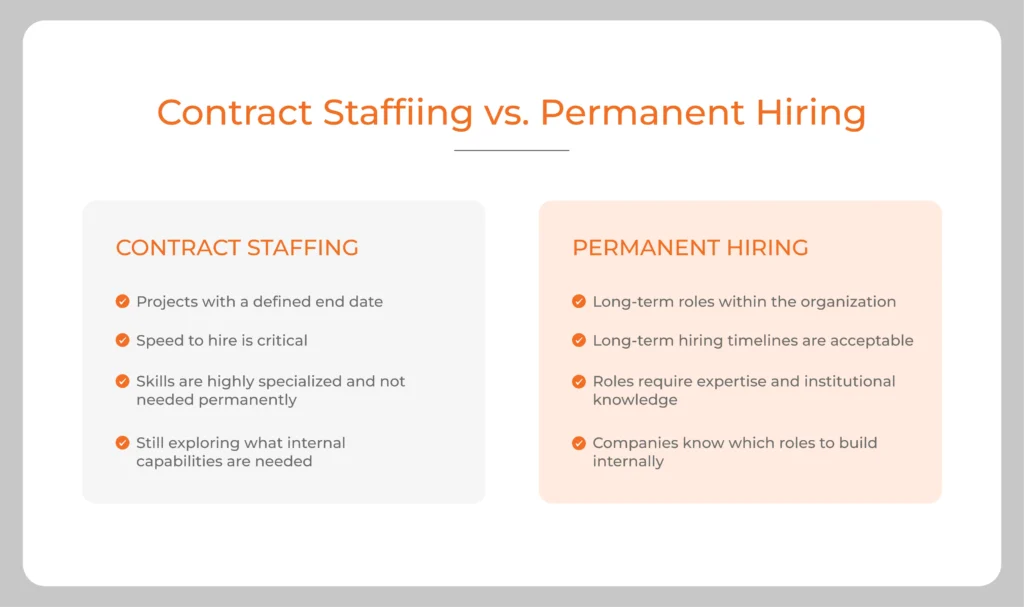
Use permanent hiring when:
- The role requires deep institutional knowledge built over time
- The position is central to ongoing product development or core operations
- Long-term culture fit and retention are the primary objectives
Most technology leaders in Canada right now are managing a mix of both. Permanent teams form the strategic core. IT contract staffing fills the specialized, time-sensitive gaps that would otherwise slow critical work down.
Also Read: Staff Augmentation vs. Direct Hire: Cost Comparison
Building a Workforce Model That Works for Canada
Canada’s tech talent shortage will persist through the near term, and the structural factors behind it run deep. Graduate pipelines are producing generalists while industry demands specialists, and global competition for senior technical talent continues to intensify.
What separates organizations making progress is how deliberately they have responded. The ones moving their digital transformation hiring forward have built workforce models flexible enough to operate within a constrained market, with IT contract staffing as a core part of how specialized capacity gets deployed.
SPECTRAFORCE specializes in contract staffing for tech companies across Canada, placing specialized IT contractors quickly, compliantly, and with the context that makes a difference on day one. If your team is carrying open roles that are slowing critical work, a 15-minute conversation is a practical place to start.
FAQs
With direct hiring, a company runs a full search, interviews, and onboards a permanent employee, typically a three to six-month process for specialized tech roles. With contract staffing, a staffing partner places a vetted professional on a defined engagement and handles compliance throughout. Access is faster, the cost commitment is lower, and the flexibility is higher. The tradeoff is less institutional knowledge building, which is why most technology teams use both models in parallel rather than choosing one over the other.
IT contract staffing is often more cost-effective than permanent hiring for project-based or specialized needs. Companies working with a defined engagement scope avoid the long-term financial commitments that come with permanent headcount. The higher day rate of a contractor is typically offset by faster placement and the absence of severance obligations when the project closes.
The timeline to hire IT contractors Canada-wide varies by role and region, but contract staffing consistently moves faster than permanent hiring. For high-demand roles like DevOps or cloud architecture, a capable staffing partner with an established candidate pool can place within days to a few weeks, compared to the months a permanent search typically requires in Canada’s tight tech market.
When a contractor has built institutional knowledge, proven cultural fit, and the need for the role has shifted from project-based to ongoing, conversion becomes a logical option. Many Canadian companies use contract engagements as a lower-risk way to evaluate talent before committing to a permanent offer.
Depth of candidate pool in your specific roles, track record of placements in your region, compliance capability across provincial employment standards, and industry context. A partner who understands the difference between staffing a fintech team in Toronto and a logistics technology team in Calgary will consistently outperform one who does not.