
A Chief Technology Officer is responsible for setting the technology strategy that keeps a company’s infrastructure and engineering capability aligned with its long-term growth goals.
But before you hire a CTO, it helps to be clear on what the role actually demands at your stage.
Most founders know they need one eventually. For some, a fractional CTO for startups is the right entry point before a full-time hire becomes necessary. But the harder question is: when, what to look for, and how to find someone who can scale with the company rather than just serve the version of it that exists today. Below is a detailed breakdown of how to hire a CTO for your startup.
When to Hire a CTO
Knowing when to hire a CTO is one of the most consequential timing decisions a founder makes. Bring one in too early, and the company does not yet have the foundation to absorb a strategic executive. Wait too long, and technical debt builds while engineering teams operate without clear direction.
The right moment typically arrives when at least two of the following are true:
- Your product has moved past MVP and requires deliberate architectural decisions to scale
- Engineering headcount is growing and needs structured leadership
- Technical choices are directly influencing your product roadmap and investor conversations
- You are making infrastructure or compliance commitments that require executive accountability
For companies that meet some but not all of these conditions, a fractional CTO for startups can bridge the gap without the cost or commitment of a permanent hire.
Before product-market fit, what most startups actually need is a strong technical builder, someone who ships fast and iterates well. The CTO title implies strategic oversight, and introducing it before that function is genuinely required creates misalignment and complicates future leadership decisions.
That urgency is backed by data. DDI’s 2023 Global Leadership Forecast, which surveyed nearly 14,000 leaders across 50 countries, found that only 40 percent of leaders rated their company’s leadership as high quality, a 17 percent drop from 2020 and the steepest decline in a decade. For startups, where a single leadership gap in technology can stall the entire product roadmap, that context makes the CTO hire one of the highest-stakes decisions a founder will make.
Also Read: How to Build and Scale Your Startup C-Suite with Executive Search
Choosing the Right CTO Model for Your Stage
Founders looking to hire a CTO often conflate these three models, but each serves a distinct need at a different stage of growth.
| Model | Best For | Engagement | Trade-off |
| Technical Cofounder | Pre-seed to seed | Equity partner, full-time | May hit the ceiling as the company scales organizationally |
| Fractional CTO for Startups | Pre-Series A | 10–25 hrs/week, retainer | Less embedded; scope must be tightly defined |
| Full-time CTO | Post-Series A | Full-time executive | Higher cost; requires organizational readiness |
The fractional model has seen significant growth since the pandemic. According to the Bureau of Labor Statistics, fractional jobs grew by 57% between 2020 and 2022, a trend that has continued upward since. The fractional CTO for startups has moved from a contingency option to a deliberate entry point for founders who need executive-level technical guidance without the full-time cost.
A separate finding from Upwork’s 2025 Future Workforce Index puts the demand shift in sharper focus: 48 percent of CEOs say they plan to increase fractional or freelance hiring specifically to close skill gaps, a pressure that is particularly acute at the CTO level.
The model you need depends more on your stage than your ambition.
What Skills Should a Startup CTO Have?
The criteria you use to hire a Chief Technology Officer will shape your engineering culture for years, so the skillset evaluation deserves more precision than most founders give it.
At the early stage, the priority is hands-on execution. A CTO who can make fast architectural decisions and build out the first engineering team is what the company actually needs. As the organization scales, that same person needs to grow into a leadership role where roadmap ownership and stakeholder communication become the primary demands.
Skills that hold across both stages:
- Scalable, cloud-native architectural instincts
- Technical depth in domains relevant to your product (AI/ML, security, data infrastructure, platform engineering)
- Ability to communicate technical decisions clearly to non-technical stakeholders and investors
- Judgment on when to build versus buy, when to move fast versus invest in foundations
- A track record of hiring and developing strong engineers, with evidence that the teams they built outlasted their tenure.
How to Evaluate CTO Candidates
The most effective way to hire a CTO is to treat the evaluation process as a separate workstream rather than something that happens between investor calls. Interviews alone are not sufficient at this level. The most effective evaluation processes combine structured technical assessment and rigorous reference checking.
- Give candidates a real problem: A realistic architecture review or strategic scenario tied to your actual product reveals how candidates think under pressure, not just how they present.
- Go beyond the reference list: Backchannel references from peers and team members frequently surface patterns that formal reference calls miss.
- Assess stage fit alongside track record: A candidate who scaled engineering at a Series C is not automatically the right hire for a Series A. The skills required at 0–10 differ materially from those at 10–100.
- Ask how they hire: A CTO who cannot attract and retain strong engineers will limit your organization’s capability long after they have moved on.
- Watch for communication quality: How a candidate explains technical decisions to a non-technical audience tells you a great deal about how they will operate with your board and investors.
Where to Find a CTO for Your Startup
The strongest candidates for this role are rarely active on job boards. Most experienced technology executives are passive, i.e., they need to be sought rather than sourced from an applicant pool. Productive channels include:
- Founder and VC networks, particularly investors with operational exposure to technical hiring
- Technology community events, open-source communities, and engineering leadership forums
- Internal promotion of senior engineers who have demonstrated the judgment and leadership potential to grow into the role
- Executive search partners like SPECTRAFORCE, who maintain active pipelines of passive candidates not reachable through job postings
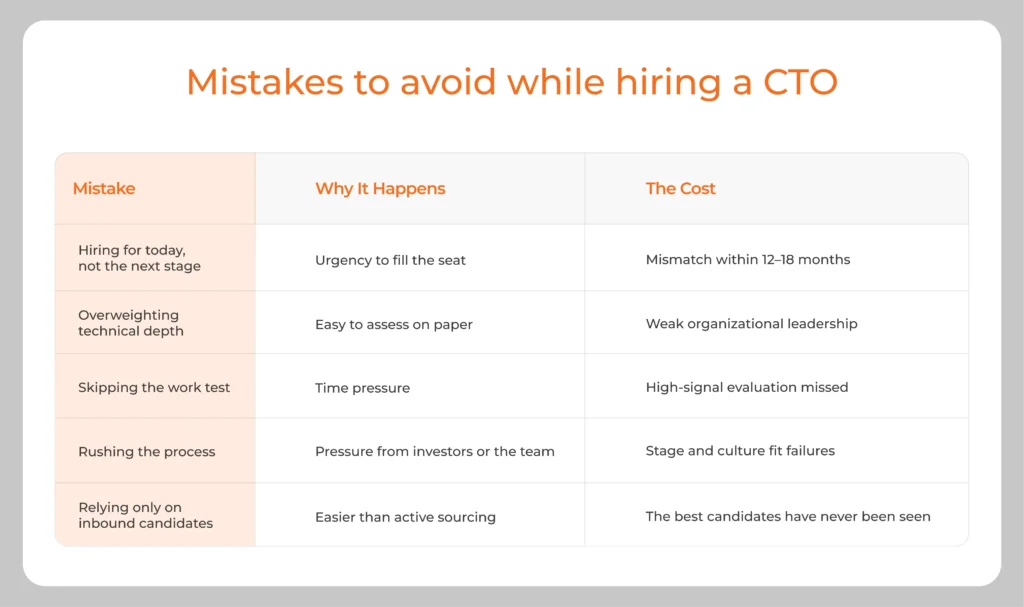
Common Mistakes Startups Make When Hiring a CTO
Most CTO hiring outcomes are determined by process decisions made before the first interview. Understanding how to find a CTO for your startup starts there.
Also Read: Executive Search in 2026: What’s Changing in Leadership Recruitment
How Executive Search for Startups Helps Get This Right
A founder-led CTO search comes with real constraints that are worth understanding before the process begins.
Technology leadership recruitment through a reliable executive search partner like SPECTRAFORCE brings two things a self-directed search typically cannot:
- Access to passive candidates who are not publicly searching and would not respond to a job posting
- A structured evaluation process designed to surface leadership capability and cultural alignment
The task here is to build a shortlist of candidates who have already been assessed across the dimensions that predict long-term success, while keeping founders focused on running the business rather than running a search.
SPECTRAFORCE partners with growth-stage companies to hire Chief Technology Officers and technical leadership, placing leaders who match both the technical requirements and the organizational moment. If you are preparing for this search, a 15-minute conversation with our team is a good starting point.
FAQs
When the product has moved past MVP, technical decisions directly shape the roadmap and investor conversations. Hiring too early, before the company has the operational foundation for an executive, creates misalignment and dilutes accountability at the build stage.
Technical execution and engineering hiring ability at early stages; organizational leadership and stakeholder communication as the company scales. Cultural alignment and stage fit matter as much as credentials.
Pre-Series A companies with a defined need for strategic oversight often benefit from a fractional CTO model. Post-Series A, with a growing team and an expanding roadmap, a full-time hire becomes the more appropriate structure. The decision should be driven by stage more than by what sounds more impressive.
Startups can find qualified CTO candidates through founder and VC networks, though the most experienced technical leaders are rarely actively searching. Engineering leadership communities and executive search partners with access to passive candidates tend to surface stronger profiles than open job postings.
By providing access to passive candidates not publicly searchable, running structured assessments that evaluate stage fit and leadership capability, and managing the process so founders can stay focused on the business rather than the search.