The energy workforce has become one of the most constrained talent markets in North America.
Grid modernization and utility-scale renewable builds are accelerating simultaneously, and the hiring pressure behind each program is compounding.
According to the IEA World Energy Employment 2025 report, more than half of the 700 surveyed energy firms are already reporting critical hiring bottlenecks that are delaying projects and raising infrastructure costs.
For HR leaders and talent acquisition teams at energy and infrastructure companies, this is the operating reality. The energy workforce gap is structural and deepening. The organizations closing it are the ones treating energy workforce planning as a deliberate strategic function, moving beyond reactive hiring toward a model built around how energy projects actually get delivered.
Energy workforce staffing is the sourcing and deployment of specialized technical talent structured around the specific phases of energy programs. For large-scale infrastructure work, getting that structure right is the difference between projects that stay on schedule and those that fall behind.
Why the Energy Workforce Gap Is Getting Harder to Close
The shortage is concentrated in roles that sit on the critical path of every major energy project. Each carries its own supply constraint and consequence for the schedule when unfilled.
- Grid engineers and power systems specialists: Average time-to-fill runs six to nine months. Delays on these energy workforce positions cascade into every downstream milestone on grid modernization and transmission programs.
- High-voltage electricians and lineworkers: Experienced candidates field competing offers within days of becoming available, and the qualified talent pool is shrinking as senior workers move toward retirement.
- Renewable energy technicians: Wind and solar installations are scaling faster than training programs can produce the commissioning and O&M talent required to staff them.
- SCADA and control systems engineers: Demand is intensifying as grid modernization investment accelerates, and candidates with the right certifications are consistently in short supply.
- Battery storage specialists: Installed capacity is growing rapidly, and the commissioning expertise required to operate these systems has not kept pace.
The energy workforce bench is thinning across all seniority levels. Senior practitioners are retiring faster than they are being replaced, and the institutional knowledge they carry takes years to rebuild.
Also Read: How AI and Automation Are Changing Staffing Solutions
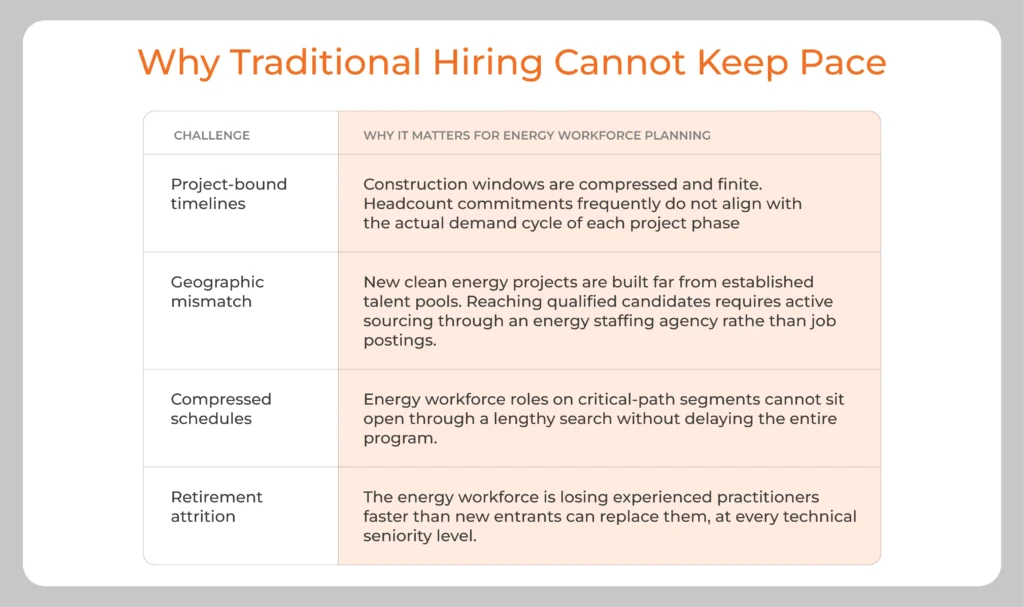
Why Traditional Hiring Cannot Keep Pace
Permanent hiring was designed for stable, ongoing roles. Most energy infrastructure work does not fit that model. The structural mismatches that make reactive hiring expensive:
How Energy Staffing Solutions Work in Practice
The energy companies making measurable progress are using blended models. A permanent core covers long-term organizational capability. Specialized contract capacity sourced through renewable energy staffing partners fills the energy workforce gaps by project phase. Energy staffing solutions make that approach repeatable and scalable.
What this looks like in practice:
- Phase-aligned deployment: Renewable energy talent acquisition partners map candidate availability to project milestones, putting specialists on site when the energy workforce need is greatest.
- Access to passive candidates: An energy staffing agency with deep sector relationships maintains active pipelines of grid engineers and substation specialists who are not reachable through open job postings.
- Compliance-ready placements: The Inflation Reduction Act prevailing wage and apprenticeship requirements unlock a 5x tax credit multiplier for qualifying projects. Energy staffing solutions that deliver IRA-compliant placements provide measurable financial value beyond the hire itself.
- Faster mobilization: Energy talent recruitment through a sector-specialist partner consistently reduces time-to-fill on hard-to-source roles. Renewable energy talent acquisition through an established partner also brings pre-vetted candidates who are deployment-ready from day one.
Also Read: Project Staffing Solutions: When and How to Use Them
Building an Energy Workforce Strategy That Scales
The energy workforce gap will not close through better job postings. The pace of retirement and the evolving skill requirements of grid and renewable energy work both require a more deliberate approach.
The workforce strategies holding up under this pressure share a common structure:
- Talent planning begins at project inception, before roles open
- Contract and permanent models are deployed by phase, based on what the work actually demands
- Renewable energy staffing capacity is built before it is urgently needed
- Energy staffing agency relationships are treated as delivery partnerships with defined performance standards
- Energy talent recruitment is measured against project milestones alongside time-to-fill
SPECTRAFORCE partners with energy and infrastructure companies across the US and Canada, placing specialized technical talent for permanent roles and project-based engagements. If you are working through an energy workforce challenge, let’s talk.
FAQs
Energy companies hiring talent for the energy transition are increasingly moving away from purely permanent search models toward blended workforce strategies that combine direct hiring, contract staffing, and staff augmentation.
The roles most critical to transition programs are grid engineers, renewable energy technicians, and SCADA specialists that sit in a constrained talent market where passive sourcing through established staffing partners consistently outperforms open job postings.
The skills most in demand in the energy transition workforce include grid engineering and power systems design, SCADA and control systems expertise, high-voltage electrical work, battery storage commissioning, and renewable energy O&M.
As grid modernization investment accelerates, candidates who combine technical depth with experience on large-scale infrastructure programs are commanding the most competitive offers.
The workforce challenges energy companies face during the energy transition are structural rather than cyclical. Qualified candidates for critical-path roles are retiring faster than new entrants can replace them, project timelines are compressed in ways that permanent hiring cycles cannot accommodate, and new clean energy projects are being built in locations that sit well outside established talent pools.
Energy companies can build a future-ready workforce for renewable energy projects by treating talent planning as a project management function rather than a reactive HR process. The most effective approach is to map role requirements to project phases before ground is broken, so that staffing partners have enough lead time to build the right candidate pipeline.
Organizations that engage renewable energy staffing partners early consistently mobilize faster and with less schedule disruption than those that begin sourcing after a role opens.
Energy firms should hire full-time employees or contract talent for energy infrastructure projects based on the nature and duration of the work. Permanent hires make sense for roles that require ongoing institutional knowledge and long-term organizational capability. Contract and staff augmentation models are better suited to project-bound work and situations where the demand cycle does not justify permanent headcount.
Workforce partners help energy companies scale hiring for large energy projects by providing access to pre-vetted candidates in roles that take 60 to 90 days or longer to fill through internal search.
A specialist energy staffing agency maintains active pipelines of grid engineers and renewable energy professionals who are not visible through standard job boards, and can align candidate deployment to the specific phases of a project rather than filling seats in isolation.